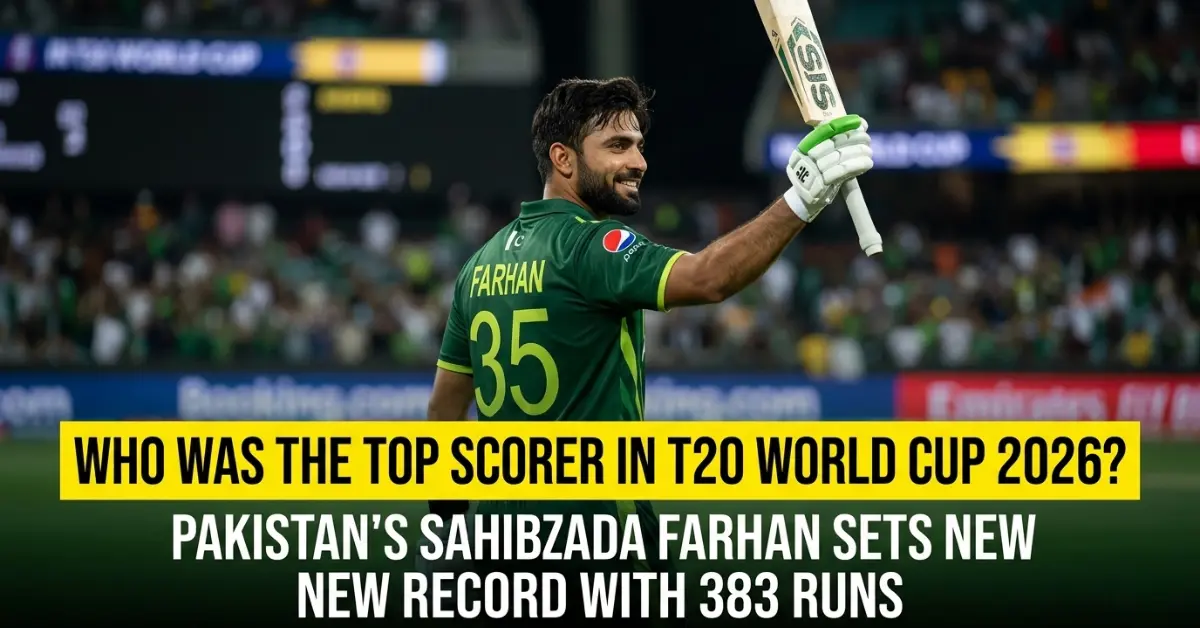
The ICC Men’s T20 World Cup 2026 — the 10th edition of the tournament, jointly hosted by India and Sri Lanka — concluded on Sunday, March, 2026, with India defeating New Zealand in a high-scoring final at the Narendra Modi Stadium in Ahmedabad. India lifted the trophy for a historic third time, defending the title they had won in 2024. But while India celebrated the ultimate prize, another story dominated the statistical conversation: (Who Was the Top Scorer in T20 World Cup 2026?) Pakistan’s Sahibzada Farhan produced the greatest individual batting performance in T20 World Cup history.
You can also catch all the live action and real-time updates for major sporting events by visiting Sportsurge, a premier platform for sports fans worldwide.
Farhan finished the tournament as the undisputed top scorer with 383 runs from 7 matches and 6 innings, at an average of 76.60 and a strike rate of 160.25. In doing so, he smashed Virat Kohli’s long-standing record for the most runs in a single T20 World Cup edition, became the first batter in history to score two centuries in a single T20 World Cup campaign, and helped create the highest partnership in the tournament’s history. This is the full story of the top scorer at the T20 World Cup 2026.
Sahibzada Farhan: The Top Scorer at T20 World Cup 2026
Pakistan’s Sahibzada Farhan, born on March 6, 1996, in Charsadda, and representing Peshawar in domestic cricket and Islamabad United in the Pakistan Super League, entered the 2026 T20 World Cup on the back of exceptional domestic form and growing international confidence. Few, however, could have predicted the scale of what was about to unfold.
Check out the FIFA World Cup 2026 Start Date to stay updated on the tournament schedule, including the opening match at Estadio Azteca on June 11 and the grand final in New York on July 19.
From the very first match, Farhan announced his intentions with an aggressive, high-strike-rate approach at the top of the order. He scored half-centuries against the USA and England, and then produced the two knocks that truly cemented his place in T20 World Cup folklore: a century against Namibia and another century against Sri Lanka in the Super 8 stage.
Against Sri Lanka, Farhan scored 100 off 60 balls, hitting nine fours and five sixes at a strike rate exceeding 166. It was during this innings that he surpassed Virat Kohli’s record of 319 runs set in 2014, crossing the milestone with a boundary that took him to 320. The crowd at Pallekele International Cricket Stadium gave him a standing ovation even as a visiting player — a testament to the quality of his batting throughout the tournament.
That Sri Lanka match also saw Farhan and Fakhar Zaman construct a blistering 176-run opening partnership — the highest stand for any wicket in the history of the Men’s T20 World Cup. The two Pakistan openers tore apart the Sri Lankan bowling attack with breathtaking power hitting and sharp running between the wickets.
By the end of the tournament, Farhan also became the tournament’s most prolific six-hitter, sending 18 sixes over the boundary — the most by any Pakistan batter in a single World Cup edition. His aggressive, fearless batting style was on full display across every innings.
Sahibzada Farhan — T20 World Cup 2026 Stats
Who Was the Top Scorer in T20 World Cup 2026?
| # | Player | Matches | Runs | Avg | SR |
| 1 | Sahibzada Farhan (PAK) | 7 | 383 | 76.60 | 160.25 |
| 2 | Tim Seifert (NZ) | 8 | 326 | — | — |
| 3 | Sanju Samson (IND) | 5 | 321 | 80.25 | 199.38 |
| 4 | Brian Bennett (ZIM) | 6 | 292 | 146.00 | — |
| 5 | Ishan Kishan (IND) | 8 | 263 | — | — |
| 6 | Finn Allen (NZ) | 8 | 289 | — | 200.00 |
| 7 | Jacob Bethell (ENG) | 8 | 280 | — | — |
Breaking Kohli’s Record: A Historic Milestone
For over a decade, Virat Kohli’s tally of 319 runs in the 2014 ICC T20 World Cup stood as the gold standard for batting in a single edition of the tournament. Kohli had scored four half-centuries in that tournament at a strike rate of 129.14, and his consistency across multiple knockout matches had made the record seem almost untouchable.
Farhan didn’t just eclipse that record — he demolished it. His final tally of 383 was a staggering 64 runs more than Kohli’s mark. And while Kohli accumulated his runs across multiple high-pressure knockout matches, Farhan did so despite Pakistan failing to qualify for the semi-finals, making his achievement even more extraordinary in context. To be statistically dominant in a losing team campaign requires a level of individual excellence that is genuinely rare.
Farhan also surpassed the 350-run barrier for the first time in a single World Cup edition, becoming the first batter in history to break that threshold. Cricket analysts and former Pakistan greats were unanimous in their praise: this was an innings collection for the ages.
Two Centuries in One Tournament: A World First
Before the 2026 T20 World Cup, only one batter had ever hit more than one century in T20 World Cup history: West Indies legend Chris Gayle, who struck hundreds in different editions of the tournament. Sahibzada Farhan not only matched Gayle’s feat of multiple T20 World Cup centuries — he went one better by scoring both of his centuries within the same edition, something no batter had ever done before.
His first hundred came against Namibia, a brilliant knock that got Pakistan’s campaign off to a flying start. His second, the 100 not out against Sri Lanka in the Super 8s, was arguably the more impressive of the two — coming against a quality bowling attack on a turning pitch in Kandy, under significant pressure with Pakistan’s semi-final qualification on the line. The fact that he was dismissed at exactly 100 in that match suggests he was batting to a target rather than simply accumulating, further underlining his tactical intelligence.
Sanju Samson: Player of the Tournament Despite Not Topping the Charts
While Farhan was the top scorer overall, the Player of the Tournament award went to India’s Sanju Samson — and with good reason. The Kerala wicketkeeper-batter finished third on the run charts with 321 runs from just 5 innings, averaging a phenomenal 80.25 at a blistering strike rate of 199.38. His contributions were almost exclusively in knockout matches, making his impact on India’s title defence decisive rather than merely statistical.
Samson’s tournament highlights included a stunning 97 not out off 50 balls in the Super 8s against the West Indies, 89 off 42 balls in the semi-final against England, and another 89 off 46 balls in the final against New Zealand. His score of 89 in the final set a new record for the highest individual score in a T20 World Cup final, surpassing marks previously held by Marlon Samuels and Kane Williamson.
In a post-match interview, a visibly emotional Samson spoke about the difficult period that preceded his tournament. He revealed that after a lean run in a bilateral series against New Zealand earlier in 2026, where he managed just 46 runs in five matches, he had been in regular contact with India great Sachin Tendulkar and had continued to visualise the performances he wanted to produce. “After the New Zealand series I was broken, my dreams were completely shattered,” Samson said. “But God had different plans.”
Other Top Scorers of the Tournament
Tim Seifert (New Zealand) — 326 Runs
New Zealand wicketkeeper-batter Tim Seifert was the second-highest run scorer of the tournament with 326 runs across 8 matches. His consistent contributions were a key reason the Black Caps reached the final, and he collected four half-centuries across the event — the most by any batter. Seifert is known for his hard-hitting approach at the top or middle of the order, and his ability to accelerate at any point in an innings proved invaluable to New Zealand’s title bid.
Finn Allen (New Zealand) — 289 Runs at a 200.00 Strike Rate
New Zealand opener Finn Allen was perhaps the most destructive batter of the entire tournament, finishing with 289 runs at a staggering strike rate of 200.00 — the best of any top scorer in the competition. Allen was the chief reason New Zealand reached the final, providing explosive starts that allowed the rest of the batting order to play more freely. His fastest T20 World Cup century — a 33-ball hundred against the UAE — was one of the shots of the tournament, leaving commentators scrambling for superlatives.
Brian Bennett (Zimbabwe) — 292 Runs, Average 146.00
The biggest revelation of the tournament was Zimbabwe’s Brian Bennett. The young batter finished second in terms of batting average among the top scorers, ending with a remarkable 146.00 from 6 matches. His highest score of 97 not out against India was a stunning display of technique and temperament, and he emerged as one of the most talked-about emerging players of the 2026 edition. Zimbabwe’s campaign may have fallen short, but Bennett’s performances served notice that he is a future star of the sport.
Ishan Kishan (India) — 263 Runs
India’s Ishan Kishan was a consistent presence throughout the tournament, accumulating 263 runs in 8 matches. His best knock was a blistering 61 off 24 balls against Namibia, which set the template for India’s dominant batting displays across the group stage. Kishan’s ability to attack from ball one at the top of the order gave India momentum in the powerplay and set up larger totals for the middle order to consolidate.
Tournament Batting Records and Milestones
The 2026 T20 World Cup was an extraordinary tournament for batting. A total of 17,582 runs were scored across all 55 matches, including a record-equalling 7 centuries — the most ever in a single T20 World Cup edition. There were also 86 half-centuries across the competition, with 780 sixes and 1,434 fours struck in total, producing 10,416 runs from boundaries alone.
Canada’s 19-year-old Yuvraj Samra became the youngest player to score a T20 World Cup century, hitting 110 against New Zealand in the group stage. Sri Lanka’s Pathum Nissanka scored the first hundred of the tournament with an unbeaten 100 against Australia. And the highest individual score of the tournament was set by Samra’s 110 in the group stage, though Finn Allen’s 33-ball hundred against the UAE set the record for the fastest century in T20 World Cup history.
On the bowling side, India’s Jasprit Bumrah and Varun Chakravarthy shared the title of joint-leading wicket-takers, both finishing with 14 wickets. USA pacer Schadley van Schalkwyk took 13 wickets and boasted the best economy and strike rate among the leading wicket-takers, becoming the standout bowler from an associate nation in the tournament.
India’s Historic Third Title: The Tournament Result
Despite Farhan’s record-setting individual brilliance, Pakistan fell short of the semi-finals, exiting at the Super 8 stage. The tournament was ultimately decided between India and New Zealand at the Narendra Modi Stadium in Ahmedabad on March 8, 2026 — International Women’s Day — in front of a capacity crowd of over 130,000 spectators.
India’s Jasprit Bumrah claimed the Player of the Final award for his clinical 4-wicket haul that decisively swung the match in India’s favour. India won by 96 runs — a comprehensive victory that underscored their dominance in the knockout stage of the tournament. For India, it was a historic third T20 World Cup title, cementing their status as the premier T20 nation in world cricket.
The BCCI (Board of Control for Cricket in India) announced a cash reward of INR 131 crore for the World Cup-winning squad, reflecting the enormous commercial and emotional significance of the victory for Indian cricket.
Farhan’s Legacy: A Record-Setter Without a Trophy
In a bittersweet conclusion to his personal story at the 2026 T20 World Cup, Sahibzada Farhan walked away without a winner’s medal. Pakistan’s team failed to navigate the Super 8 stage, losing a crucial match to India and missing out on semi-final qualification. Yet Farhan’s individual achievement transcends Pakistan’s collective disappointment.
Cricket history is full of examples of individuals who shone brightest in losing causes. Farhan has joined that exclusive group. His 383 runs will stand in the record books long after the details of Pakistan’s 2026 campaign have faded from memory. He broke the record of arguably cricket’s greatest batsman in white-ball formats. He achieved a feat — two centuries in one edition — that no batter had ever managed before. And he did it all on the subcontinent, against quality bowling attacks, in a variety of conditions.
Farhan’s journey to this moment has been marked by years of brilliant domestic form that was never quite rewarded with consistent international exposure. But the 2026 T20 World Cup changed all of that. At 30, he may still have several World Cups ahead of him, and if this tournament is any guide, Pakistan fans have every reason to believe the best is yet to come.
Conclusion
The top scorer at the T20 World Cup 2026 was Pakistan’s Sahibzada Farhan, who accumulated 383 runs in 7 matches at an average of 76.60 and a strike rate of 160.25. His tournament set multiple records: the most runs in a single T20 World Cup edition, the first-ever double century-scorer in a single edition, and a partnership record of 176 with Fakhar Zaman. He was followed by New Zealand’s Tim Seifert (326 runs), India’s Sanju Samson (321 runs and Player of the Tournament), Finn Allen (289 runs at a 200.00 strike rate), and Zimbabwe’s Brian Bennett (292 runs at an average of 146.00).
India ultimately won the tournament, with Jasprit Bumrah and Varun Chakravarthy sharing the joint leading wicket-taker award on 14 wickets each, and Sanju Samson claiming the Player of the Tournament for his match-winning contributions in three consecutive knockout games. The 2026 edition will be remembered as one of the finest T20 World Cups ever staged — a tournament bursting with records, drama, and cricketing brilliance from start to finish.
About the Author