By March 12, 2026, the Miami (OH) RedHawks had done something only two programs in the modern era had ever managed — complete an undefeated regular season in Division I men’s college basketball. Now, a town of 23,000 in southwestern Ohio finds itself at the center of the college basketball universe.
There are stories The Miracle in Oxford in college basketball that sneak up on you. They don’t begin with fanfare or hype. They don’t start with a top recruit, a preseason top-10 ranking, or a national television deal. They start quietly — with a coach grinding through losing seasons, with a roster of transfers who didn’t fit anywhere else, with a fan base that had been waiting over two decades to feel something again. That is the story of the 2025–26 Miami RedHawks, and it is one of the most remarkable seasons the sport has ever seen.
The RedHawks, led by fourth-year head coach Travis Steele, won every game in the regular season, becoming the first MAC team ever to go undefeated through conference play. When the buzzer sounded on their 110–108 overtime thriller against rival Ohio on March 6, Miami became just the third team to complete an unblemished regular season since Gonzaga in 2021. A program that hadn’t been nationally ranked in over a quarter century had written itself into the permanent record books.
The Rebuild Nobody Saw Coming
To understand what just happened The Miracle in Oxford, Ohio, you have to understand how far this program had fallen — and how quickly Travis Steele turned it around.
Steele became head coach in 2022 after previously serving as head coach at Xavier. In his first season, he guided the RedHawks to a 12–20 overall record while reaching the MAC Tournament quarterfinals. That is not the resume of a man building toward history. It is the resume of a man fighting for his job. And yet Steele stayed the course, leaning into the transfer portal, installing an up-tempo offensive system, and demanding a culture of toughness that his earliest rosters didn’t always have the talent to match.
The progression was steady if unspectacular. In the 2023–24 season, Miami improved to 15–17. Then came a massive leap in 2024–25, when Miami posted a 25–9 record and finished 14–4 in MAC play — the program’s most conference wins since 2005–06. By the end of that year, they were knocking on the door of the MAC championship game and producing all-conference talent for the first time in years. Steele wasn’t just stabilizing the program. He was rebuilding it into something the MAC had never quite seen.
Nobody predicted the next step would be this.
Peter Suder: The Player of the Year Nobody Expected
At the center of everything Miami has accomplished is Peter Suder, a 6-foot-5 senior guard who has spent the year producing jaw-dropping performances and quietly assembling a résumé that belongs among the best mid-major seasons in recent memory.
Suder was named MAC Player of the Year and earned First-Team All-MAC honors, becoming a central figure in one of the most successful seasons in program and MAC history. His numbers tell part of the story: this season he has averaged 14.8 points, 4.8 rebounds, and 3.9 assists while shooting 56.4 percent from the floor and 42.5 percent from three-point range. For context, those shooting numbers would be outstanding at any level of college basketball.
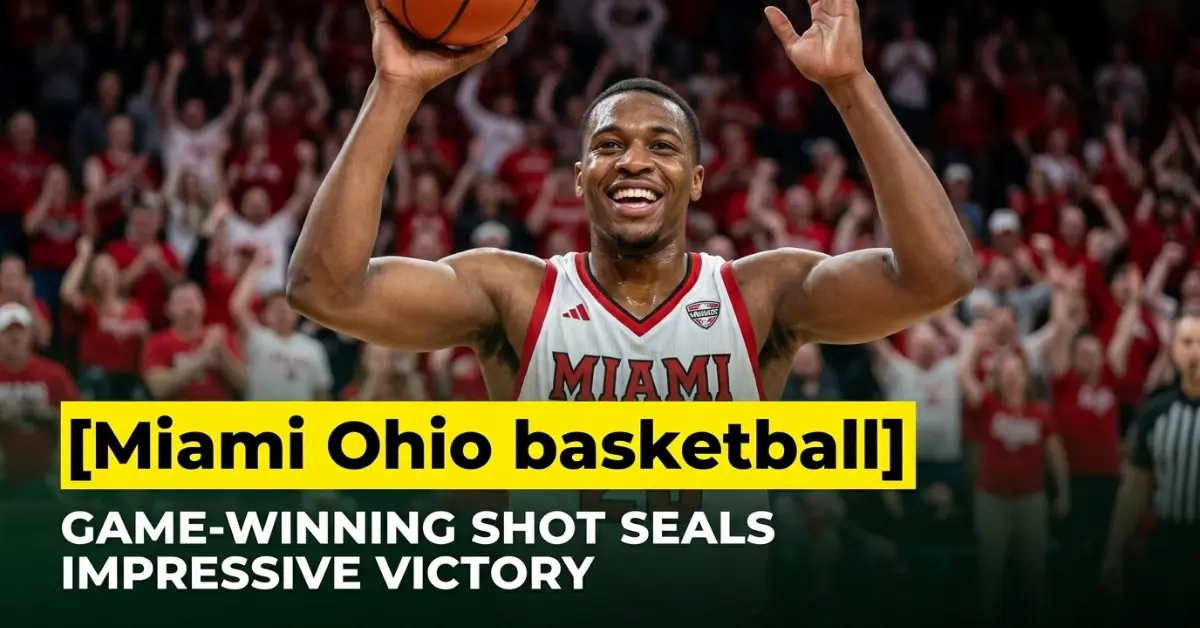
But statistics don’t do justice to the moments Suder has delivered. On January 17, facing Buffalo in an overtime game that featured 27 lead changes and eight ties, Suder posted a season-high 37 points, including seven three-pointers on ten attempts, hitting the overtime game-winning three-point shot to secure Miami’s 19th consecutive win to start the season. That victory not only tied the best start in MAC history — it vaulted Miami into the AP Top 25 for the first time since February 1999.
Three days later, on January 20, Miami achieved a 20–0 start with an overtime victory over Kent State on the road, breaking the MAC record for consecutive wins to start a season. Suder led that game with 27 points, 10 rebounds, and 8 assists — a triple-double of dominance that illustrated why opponents had no answer for him.
Then came one of the defining individual performances of the college basketball season. On December 2, Suder posted a career-high 42 points against Air Force — the most points by a RedHawk at Millett Hall and the most by any Miami player since Wally Szczerbiak scored 43 points in 1999. Szczerbiak, of course, went on to become an NBA All-Star. The comparisons are inevitable, even if Suder prefers to let his team’s record do the talking.
His family basketball roots run deep. Suder is the son of Rick Suder, a two-time All-Atlantic 10 Conference player in the 1980s. The basketball genes are real. So is the work ethic — a player who transferred from Bellarmine, rebuilt his game under Steele’s system, and elevated into one of the most complete players in the country at the mid-major level.
A Supporting Cast Built for This Moment
Suder has not carried this team alone. Brant Byers earned All-MAC Second Team recognition, Eian Elmer was also selected to the All-MAC Second Team, Luke Skaljac was placed on the All-MAC Third Team, and Antwone Woolfolk received All-MAC Honorable Mention. That is five players receiving conference recognition — an extraordinary haul that reflects the genuine depth of this roster.
Elmer, in particular, saved Miami’s perfect season in its final game. In the 110–108 overtime victory over Ohio that completed the 31–0 regular season, Elmer scored a career-high 32 points and grabbed 12 rebounds in a gritty performance against an Ohio team desperate to play spoiler on its home floor. When Miami needed someone to step up beyond Suder, Elmer delivered one of the best games of anyone’s career on the biggest stage available to the program.
The team also absorbed a significant blow early in the season. Starting point guard Evan Ipsaro was named to the 2025–26 Lou Henson Award Early Season Watch List before tearing his ACL in the December 20 victory against Ball State and being lost for the season. Losing your starting point guard before conference play might have derailed another team’s season. Miami didn’t skip a beat.
Millett Hall: The Fortress That Fueled History
Part of what has made this season so remarkable is the environment Miami created at home. The team set a school record for consecutive home wins at 31, a MAC record for consecutive conference game wins going into the tournament at 18, and a school record for consecutive road wins at 15. Those are not just conference records. The road winning streak, in particular, is what separates programs that run the table at home from programs that can genuinely impose their will anywhere.
The atmosphere at Millett Hall took on a life of its own. The Miami swim team began showing up to games wearing only their Speedo trunks in a show of winter solidarity, and head coach Travis Steele responded by committing on College GameDay to be hoisted in a swimming motion wearing only a Speedo on Selection Sunday if the team won its final six games and the MAC Tournament. The moment was spontaneous and joyful — exactly the kind of thing that happens when a team captures an entire campus and community.
College GameDay itself coming to Oxford is a statement of how significant this season became nationally. A mid-major program in the MAC doesn’t typically draw the flagship college basketball broadcast. Miami earned every second of the spotlight.
The Climb to Ranked and the Undefeated Standard
What truly separated this season from other good mid-major years was that Miami did not simply beat who they were supposed to beat. They were the first unranked team to reach 18–0 since the 1978–79 season. They won close games repeatedly — the slim margin of victory tied Miami for the most wins of three points or less by an undefeated team since 1948–49. This was not a team that bulldozed opponents. This was a team that competed, clawed, won in overtime, found the right player at the right moment, and refused to lose.
The program’s scoring output has been electric. Miami ranked second nationally in points per game at 90.9 and posted the sixth-best offensive rating in all of Division I. Under Steele’s system, the RedHawks play with pace and purpose, spacing the floor and generating quality looks through ball movement rather than isolation basketball. Suder thrives as both a catch-and-shoot threat and a pick-and-roll operator. Elmer provides a secondary creator. Byers and Woolfolk provide athleticism and energy off the ball.
On February 9, after Arizona lost to Kansas, Miami stood alone as the only unbeaten team in NCAA men’s Division I basketball. Think about what that means for a program that preseason experts predicted would finish second in its own conference. Suddenly, the RedHawks weren’t just the MAC’s best story. They were college basketball’s last remaining perfect team.
Travis Steele: The Coach Who Believed
None of this happens without Steele. He was a unanimous selection as MAC Coach of the Year — the first Miami coach to earn the award since Charlie Coles received it in 2021 years prior in 2005. That gap alone says something. Coles built the last great era of Miami basketball. Steele is building the next one, and doing so at a pace that Coles himself might not have imagined possible.
Steele was hired as head coach on March 31, 2022, becoming the 28th head coach in school history. His path to Oxford ran through Xavier, where he developed into one of the better recruiters and developers in the Big East before eventually getting the chance to run his own program. The first season tested him. The second season tested him. The third season showed he had built something real. The fourth season showed he had built something historic.
What makes Steele’s coaching so effective is the culture he has constructed — one where role players become contributors, contributors become stars, and stars like Suder become Player of the Year candidates. He has built depth at every position through the transfer portal without sacrificing cohesion, finding players whose games complement one another rather than simply collecting talent.
The Tournament Question — and What Comes Next
For all the joy surrounding this season, a sharp-edged question hangs over it: despite its magical run, Miami might need to win the MAC Tournament to guarantee a spot in the NCAA Tournament. The schedule simply did not provide the high-profile wins that drive NCAA at-large bids. The team achieved its conference title with only one Quad 2 win and no Quad 1 wins. The strength of schedule has been Miami’s Achilles heel in the national conversation all season long.
That reality makes the MAC Tournament, currently underway at Rocket Arena in Cleveland, feel like both a celebration and a pressure cooker. Miami entered the tournament as the top seed after winning its first regular-season conference title in 21 years, facing an old nemesis in UMass in the quarterfinals on March 12. The bracket includes Akron, the team that knocked Miami out of last year’s tournament championship and enters this week as the second seed with a 26–5 record of its own.
If Miami wins the tournament, they go dancing for the first time since 2007. If they fall short, they will spend Selection Sunday waiting and hoping that a committee values a 31-win season — however it was constructed — enough to include them. The suspense is real, and it is exactly the kind of late-season drama a program this good deserves.
What This Season Means
Beyond the records and the rankings and the tournament positioning, what the 2025–26 Miami RedHawks have done is remind everyone watching that college basketball’s beauty is not concentrated in the Power Four conferences. It lives in every arena in the country where a team believes in something bigger than the box score, where a coach builds from nothing, where a player finds himself in a system that fits him perfectly and maximizes everything he has.
Miami has reached the NCAA Tournament’s Sweet Sixteen four times in its history and appeared in the tournament 17 times — most recently in 2007. The names attached to those eras — Wally Szczerbiak, Ron Harper, Wayne Embry — are part of a proud tradition. The 2025–26 team is writing its own chapter alongside them, one that may ultimately be remembered as the most improbable of all.
Oxford, Ohio is not a place people usually associate with college basketball greatness. Millett Hall is not Cameron Indoor or Allen Fieldhouse. Travis Steele is not a household name, and Peter Suder was not a five-star recruit. None of that matters now. What matters is that a team came together, trusted a system, refused to lose, and carried a program from obscurity back to the national stage.
The 2025–26 Miami RedHawks have already made history. Whatever happens in Cleveland this week, that part is permanent.
About the Author