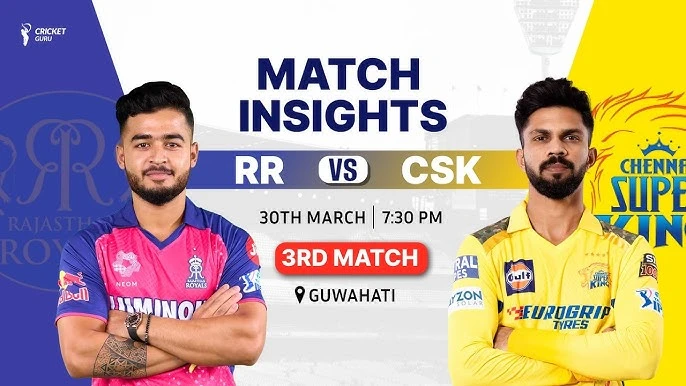
Match Date: March 30, 2026 | Venue: Sawai Mansingh Stadium, Jaipur | Tournament: Indian Premier League 2026
A Day of Pink — Rajasthan Royals Storm to a Dominant Win
The Sawai Mansingh Stadium in Jaipur was electric on March 30, 2026, as Rajasthan Royals (RR) delivered one of the most comprehensive victories of the IPL 2026 season so far, routing Chennai Super Kings (CSK) by an emphatic 8 wickets, chasing down a meagre target of 128 runs in just 12.1 overs. It was a statement win — an announcement to the rest of the tournament that the Royals mean business in 2026. For CSK, it was a chastening afternoon that laid bare serious vulnerabilities in their batting order.
The clouds hovering over Jaipur did nothing to dampen the Royals’ spirits. CSK vs Rajasthan Royals Standings 2026 | IPL, The pitch offered mild conditions with no wind and overcast skies — conditions that, in theory, should have aided the swing bowlers of both sides. But only one team managed to exploit them convincingly, and it was the home side doing all the damage.
Michigan Wolverines’ path through the 2026 NCAA Tournament.
Toss and Team Selection
Rajasthan Royals captain won the toss and elected to bowl first, a decision that proved prescient given the surface and conditions. The choice to put CSK in forced Chennai’s batsmen to negotiate early movement and pace, something they proved woefully ill-equipped to handle on the day.
Both sides fielded strong-looking XIs on paper. CSK came in riding on the reputation of a historically formidable franchise — five-time champions — but, as the match unfolded, reputation counted for little against the disciplined and inspired bowling attack that Rajasthan had assembled.
Chennai Super Kings Batting: A Collapse of Historic Proportions
CSK’s innings was a slow-motion disaster, their batsmen dismissed for just 127 all out in 19.4 overs, managing a paltry run rate of 6.46 — a deeply concerning number in the T20 format where anything below 8.0 is typically considered below par.
The rot set in almost immediately. Opening batter Sanju Samson — playing here for CSK — was bowled by pace sensation Nandre Burger in the second over, making just 6 runs off 7 balls. The loss of the experienced Samson for single digits unsettled the chase at its foundation.
Captain and trusted run-scorer Ruturaj Gaikwad provided zero momentum at the top. Bowled by the brilliant Jofra Archer in the third over, Gaikwad managed only 4 runs off 11 balls (strike rate: 36.36) — a painfully scratchy stay that lasted just 11 minutes. When a captain fails to fire and the top order crumbles, the middle order is asked to build from rubble.
UEFA Champions League 2026 bracket and fixtures.
Young opener Ayush Mhatre followed in the next ball after Gaikwad’s dismissal, caught off Nandre Burger for a duck from just one delivery — three wickets down for a combined 19 runs, and the Royals were absolutely purring.
Matt Short came in at number four and proved equally ineffective, scoring just 2 off 7 balls (strike rate: 28.57) before being caught off Sandeep Sharma in the sixth over. Four wickets down, CSK’s scorecard in ruins.
The only CSK batsman to offer any sustained resistance in the middle overs was Sarfaraz Khan, who provided moments of aggression — 17 runs off 12 deliveries, including a six and two fours at a strike rate of 141.67 — before falling LBW to the excellent Ravindra Jadeja in the eighth over. Shivam Dube contributed a brief cameo of 6 off 4 balls (one six), but with so little support around him, it amounted to very little.
Kartik Sharma showed some lower-order grit, scoring 18 off 15 deliveries (strike rate: 120), while Jamie Overton proved CSK’s best performer with a fighting knock of 43 runs off 36 balls, including two sixes and two fours, before being run out in the final over. Overton’s was a valiant display — a number eight scoring the top runs for a side is never a good omen.
Noor Ahmad (1 off 9 balls), Matt Henry (5 off 7), and Anshul Kamboj (7 off 10) all failed to contribute meaningfully, and CSK’s innings ended in the 20th over, dismissed for 127. Only 8 fours and 5 sixes from 127 runs tell the story of an innings that was bereft of intent, timing, and composure.
CSK Batting Summary (Key Performers)
- Sanju Samson: 6 (7 balls) — Bowled, Burger
- Ruturaj Gaikwad: 4 (11 balls) — Bowled, Archer
- Sarfaraz Khan: 17 (12 balls) — LBW, Jadeja
- Jamie Overton: 43 (36 balls) — Run Out (top scorer)
- Kartik Sharma: 18 (15 balls) — LBW, Brijesh Sharma
Rajasthan Royals Bowling: Ruthless, Disciplined, Devastating
If CSK’s batting was the story of failure, Rajasthan’s bowling was the story of excellence. Six different bowlers contributed, each extracting value from the conditions and building enormous pressure in a collective performance that never gave Chennai any breathing room.
Jofra Archer was the pick of the bowlers, finishing with figures of 2/19 from 4 overs — an economy rate of 4.75, remarkable in T20 cricket. Archer bowled with genuine pace and movement, beating edges and finding the stumps. His return to the IPL has clearly been worth every penny and every ounce of anticipation. His spell in the powerplay set the tone: tight, dangerous, and unrelenting.
Nandre Burger was equally devastating, taking 2 wickets for 26 runs from 4 overs — removing the dangerous Samson and the hapless Mhatre. Burger’s ability to bowl at pace with a scrambled seam has been a revelation, and his economy rate of 6.5 in these conditions was commendable.
Ravindra Jadeja was the spinner in the attack who excelled, claiming 2/18 from 3 overs (economy: 6.0) — removing Sarfaraz Khan and Shivam Dube in a spell that killed any hope of a CSK recovery. Jadeja is a master of the craft, varying pace, extracting turn, and denying runs as much as taking wickets.
Ravi Bishnoi added a wicket (1/16 from 3 overs, economy: 5.33), and debutant spinner Brijesh Sharma impressed enormously with 1/17 from 3 overs (economy: 5.67) — showing maturity beyond his experience. Sandeep Sharma chipped in with 1 for 22 from 2.4 overs.
RR Bowling Summary
| Bowler | Overs | Runs | Wickets | Economy |
|---|---|---|---|---|
| Jofra Archer | 4 | 19 | 2 | 4.75 |
| Nandre Burger | 4 | 26 | 2 | 6.50 |
| Ravindra Jadeja | 3 | 18 | 2 | 6.00 |
| Ravi Bishnoi | 3 | 16 | 1 | 5.33 |
| Brijesh Sharma | 3 | 17 | 1 | 5.67 |
| Sandeep Sharma | 2.4 | 22 | 1 | 8.25 |
Rajasthan Royals Chase: Vaibhav Suryavanshi’s Explosive Brilliance
When Rajasthan Royals walked out to chase 128, the match was effectively already over from a probability standpoint — but nobody told the crowd, and nobody told teenage sensation Vaibhav Suryavanshi. The 14-year-old prodigy from Bihar, one of the most talked-about prospects in world cricket, delivered an innings that defied both age and gravity.
Suryavanshi opened and played one of the most audacious T20 knocks in recent IPL memory, hammering 52 runs off just 17 balls — an extraordinary strike rate of 305.88. He struck 4 fours and 5 sixes in an innings that lasted barely 32 minutes at the crease. By the time he was caught off Anshul Kamboj in the seventh over, the game was essentially done. That a 14-year-old plays with such fearlessness, clarity of shot selection, and savage power suggests the next decade of Indian cricket is in exceptional hands.
Opening partner Yashasvi Jaiswal was the perfect foil — measured, sensible, accumulating his runs patiently to finish unbeaten on 38 off 36 balls (strike rate: 105.56). Jaiswal’s 3 fours and 1 six, spread over 60 minutes, gave the innings a backbone of composure. He and Suryavanshi put on 75 runs for the first wicket in just 38 balls — a partnership that made the chase seem like a stroll in the Jaipur sun.
After Suryavanshi’s departure, Dhruv Jurel showed his class with a brisk cameo of 18 off 9 balls (strike rate: 200), striking 4 fours in his short but valuable stay. He was bowled by Kamboj in the ninth over, but by then RR needed fewer than 30 runs from more than 60 balls — a formality.
Riyan Parag, the local Jaipur hero, arrived at number four and added 14 not out off 11 balls, and Jaiswal saw the team home as RR crossed the line in just 12.1 overs, winning by 8 wickets with 47 balls to spare. The winning shot was greeted by a thunderous roar from the pink-clad Jaipur faithful.
RR Batting Summary (Chase)
- Vaibhav Suryavanshi: 52 (17 balls) — Caught, Kamboj ⭐ Star of the Match
- Yashasvi Jaiswal: 38* (36 balls) — Not Out
- Dhruv Jurel: 18 (9 balls) — Bowled, Kamboj
- Riyan Parag: 14* (11 balls) — Not Out
CSK Bowling in the Chase: Powerless Against the Storm
CSK’s bowlers had no answer to the Royals’ batting juggernaut. Matt Henry was the most expensive, conceding 40 runs from 3 overs (economy: 13.33) with no reward, completely neutralised by Suryavanshi’s assault from the off. Noor Ahmad went for 24 from 2 overs at 12.0, while Khaleel Ahmed was the most economical, giving away just 17 from 3 overs (5.67) but without penetration on a day when the pitch offered batting paradise.
Anshul Kamboj was CSK’s best bowler, taking both wickets (2/27 from 3 overs, economy: 9.0), but by the time he dismissed Suryavanshi and Jurel, the match was long beyond saving. Jamie Overton — still recovering from his earlier batting duties — conceded 14 from 1 over at an economy of 14.0.
IPL 2026 Standings Context — What This Result Means
With the 2026 IPL season barely off the ground, every result carries magnified weight in the standings. Here is what we know from the opening round of fixtures:
Match 1 — March 29: Mumbai Indians beat Kolkata Knight Riders by 6 wickets at Wankhede Stadium. KKR posted a competitive 220/4, but MI’s Rohit Sharma (78 off 38) and Ryan Rickelton (81 off 43) demolished the target in 19.1 overs.
Match 2 — March 30: Rajasthan Royals beat Chennai Super Kings by 8 wickets at Sawai Mansingh Stadium. This result confirmed.
Early IPL 2026 Table (After Opening Matches)
- Mumbai Indians — 1 match, 1 win, 2 points
- Rajasthan Royals — 1 match, 1 win, 2 points
- Kolkata Knight Riders — 1 match, 1 loss, 0 points
- Chennai Super Kings — 1 match, 1 loss, 0 points
The next fixture is Punjab Kings vs Gujarat Titans on March 31, 2026, which will further fill out the early standings picture.
The Bigger Picture: Key Takeaways
For Rajasthan Royals, this was a performance that ticked every box. The bowling attack was disciplined and varied — pace from Archer and Burger, spin from Jadeja and Bishnoi — and the batting was explosive at the top through Suryavanshi and calm in the middle through Jaiswal. The balance of this side looks exceptional, and if Suryavanshi continues to play with this kind of fearlessness, they will be a headache for every team in the competition.
Jofra Archer back to full fitness and bowling at 90+ mph is a terrifying prospect for every IPL batsman. His 2/19 from 4 overs was as controlled a powerplay spell as you will see. He sets the tone, he creates pressure, and he takes wickets — the complete package.
Vaibhav Suryavanshi at 14 years old scoring 52 off 17 balls including 5 sixes is, simply put, one of the most jaw-dropping stories the IPL has ever produced. The teenager from Saharsa, Bihar, who became the youngest player to score a half-century in IPL history, played shots that most seasoned internationals would struggle to replicate. Scoops over fine leg, flat-batted drives over mid-off, and pulled sixes off the front foot — his innings was simply extraordinary.
For Chennai Super Kings, the alarm bells are ringing loudly after just one match. The batting looked fragile from the very first over, with Gaikwad’s failures a particular concern. A T20 innings of 127 all out against a quality bowling attack is below par, and the dismissal sequence — wickets falling in clusters, no partnerships of substance until the lower order — suggests structural problems in the batting lineup. Fifteen overs to address before their next fixture.
The absence of big-name firepower early in the innings proved fatal. CSK’s batting relied too heavily on individual brilliance that never materialised; their only significant contribution came from number eight Overton, which says everything about where the innings went wrong.
Historical Context: CSK vs RR in the IPL
The Chennai Super Kings and Rajasthan Royals are two of the most storied clubs in IPL history. CSK, led by the legendary MS Dhoni for much of the franchise’s existence, boast five IPL titles (2010, 2011, 2018, 2021, 2023) and are historically the gold standard of consistency. The Royals, meanwhile, won the inaugural IPL in 2008 and reached the final again in 2022 under Sanjiv Goenka’s ownership. Their head-to-head record across 18-plus years of IPL cricket has been closely contested, making each encounter significant in terms of prestige, standings, and psychological momentum.
Today’s result — a comprehensive 8-wicket thumping — gives Rajasthan a powerful psychological edge going into the rest of the season. More importantly, it confirms that the Royals’ squad depth, particularly the emergence of Suryavanshi alongside the experience of Jaiswal, Jadeja, and Archer, makes them genuine title contenders in 2026.
Star Performer of the Match
Vaibhav Suryavanshi (RR) — 52 off 17 balls, strike rate 305.88, 4 fours, 5 sixes. He is, at 14, the most electrifying young talent cricket has seen in a very long time.
What’s Next
Punjab Kings vs Gujarat Titans — March 31, 2026 (14:00 IST, Mullanpur/Home Ground of PBKS)
This fixture will be the third match of IPL 2026 and could provide early indications of how GT under Shubman Gill shapes up, and whether PBKS can replicate the early-season form that has made them a dangerous dark horse in recent editions.
For CSK and RR, their next fixtures are awaited with great interest. Rajasthan will look to build on this platform and cement themselves at the top of the table, while CSK desperately need a performance from their top order to avoid an early-season crisis of confidence.
About the Author