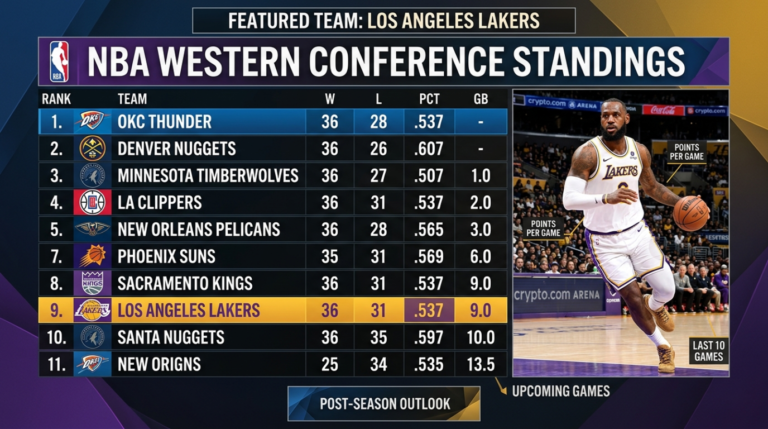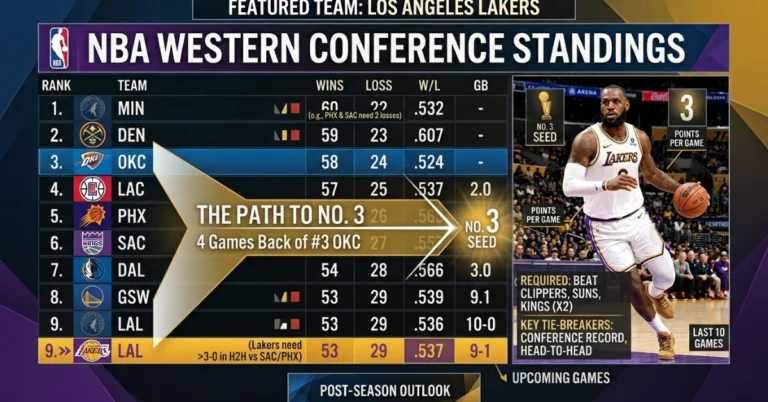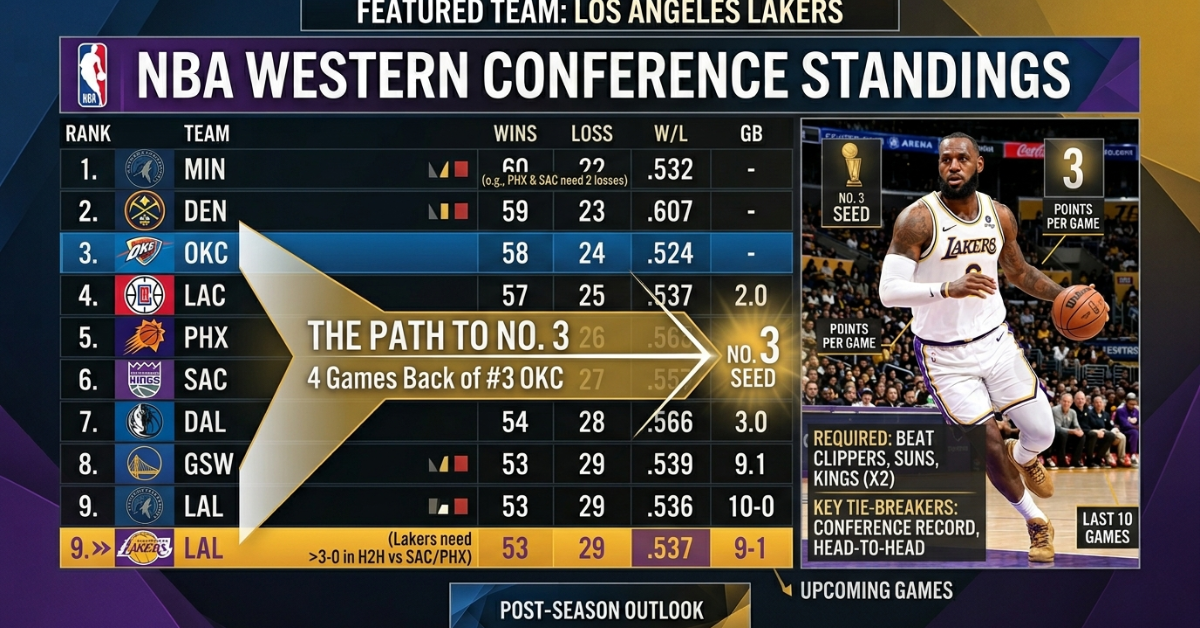
The Los Angeles Lakers have one game remaining in their 2025-26 regular season, and with it comes a critical opportunity: the chance to claim the No. 3 seed in the Western Conference and avoid playing against the Denver Nuggets in the first round. Currently sitting at 52-29 with a game against the Utah Jazz on Sunday evening, the Lakers find themselves just one game behind the defending champion Nuggets (53-28) with a direct path to improving their playoff position—if circumstances align favorably.
The seeding battle between Los Angeles and Denver has become one of the most compelling storylines heading into the final day of the NBA regular season. What once seemed like an almost certain No. 3 seed finish for the Lakers in early April has transformed into a scenario where they must depend on both their own performance and external factors. Understanding how the Lakers can climb one seed and the cascading implications of that move reveals much about playoff positioning, tiebreaker rules, and the strategic considerations teams must navigate down the stretch.
The Current Situation: Lakers at 52-29, One Game Behind Denver
As the 2025-26 regular How Can Lakers Jump to No. 3 Seed in West? enters its final day on Sunday, April 12, the playoff picture in the Western Conference is almost entirely settled—except for one crucial detail: the battle for the No. 3 seed between Los Angeles and Denver. This competition represents the only remaining seeding uncertainty among the top six teams in the West.
The Lakers and Nuggets are the only two teams that can end the final day in a different spot than where they started, with Denver at 53-28 in third place and Los Angeles at 52-29 in fourth. This setup creates a mathematically simple but circumstantially complex scenario: one team will move up or hold serve, and the other will either stay put or slip backward.
The Oklahoma City Thunder and San Antonio Spurs have locked in the No. 1 and No. 2 seeds, respectively. The Houston Rockets have clinched the No. 5 seed, while the Minnesota Timberwolves are locked into the No. 6 seed. The play-in tournament teams in the West (Nos. 7-10) have similarly been determined, with only minor jockeying possible among those teams.
This means that when the Lakers take the court against Utah on Sunday, the game has profound implications not just for Los Angeles but for the entire playoff structure and first-round matchups that will shape the postseason narrative.
The Lakers’ Path to No. 3: Beat Utah, Hope for Denver Loss
The mathematics of the Lakers’ path to the No. 3 seed are straightforward, but success requires specific outcomes. The Lakers can jump the Nuggets for No. 3 if they beat the Jazz on Sunday and the Nuggets lose to San Antonio. That’s it. Two conditions must be met for Los Angeles to leapfrog Denver.
The Lakers’ portion of the equation appears manageable on its surface. Utah represents one of the worst teams in the NBA, a squad explicitly tanking for lottery positioning ahead of the 2026 NBA Draft. The Jazz are tied for the fourth-best odds in the draft lottery and have no incentive to win games. From a team-quality standpoint, the Lakers should handle Utah comfortably, even if operating without key pieces like Luka Doncic and Austin Reaves.
The Utah Jazz have essentially shut down their season. Playing against a lottery-focused opponent should theoretically be an advantageous matchup for a playoff-aspiring team like the Lakers. Los Angeles has the talent, experience, and motivation to secure a victory against a tanking team. With LeBron James still operating at an elite level and role players stepping up in the absence of Doncic and Reaves, a Lakers victory against Utah would be the expected outcome.
The external condition—Denver losing to San Antonio—is where uncertainty enters the equation. Denver has won 11 straight games heading into Sunday’s regular-season finale, but if the Nuggets lose and the Lakers win Sunday, they will fall to fourth. The Nuggets’ hot streak heading into the final game suggests they’re peaking at exactly the right time, which is typically beneficial for a team entering the playoffs.
However, San Antonio’s situation presents an interesting wrinkle. The Spurs have already locked in the No. 2 seed and have nothing to play for in terms of their own seeding. Historically, teams with nothing at stake tend to rest their starters and key rotation players in the final game of the regular season. This dynamic could create vulnerability for Denver.
The Tiebreaker Advantage: Lakers Have the Edge
A crucial detail in understanding the Lakers’ path to the third seed involves the tiebreaker mechanism that would apply if both teams finished with identical records. Los Angeles and Denver would be tied, but the Lakers have the tiebreaker thanks to that wild game a few weeks back where Austin Reaves’ intentionally-missed free throw rebound and bucket forced overtime, then Luka Doncic won it in OT with an amazing baseline jumper.
This head-to-head tiebreaker is critical. If the Lakers and Nuggets both end up 53-29, Los Angeles wins the tiebreaker and claims the No. 3 seed. This means the Lakers have a slight mathematical advantage: they can reach the third seed by winning while Denver stays put, but Denver requires a win to guarantee third place (unless the Lakers lose).
The tiebreaker advantage adds another layer of intrigue to Sunday’s matchups. It means that even if Denver plays well against a resting Spurs team, the Lakers still have a path to third if they secure their victory. The complexity of these scenarios has led to extensive analysis across the NBA media landscape, with various outlets breaking down the likelihood of each outcome.
Scenario Analysis: All Possible Outcomes
The playoff seeding outcome on Sunday breaks down into essentially three distinct scenarios, each with different implications for the Lakers and Nuggets moving into their first-round matchups.
Scenario One: Both Teams Win (Most Likely)
If both the Lakers beat Utah and Denver beats San Antonio, the seeding remains as is. Los Angeles finishes at 53-29, Denver finishes at 54-28, and the Nuggets hold the No. 3 seed while the Lakers settle into fourth. In this scenario, the Lakers would face the Houston Rockets in the first round, while Denver would match up against the Minnesota Timberwolves.
From the Lakers’ perspective, this outcome isn’t catastrophic. The Rockets have had a tumultuous season under Kevin Durant and haven’t demonstrated the same level of consistency the Lakers would face against Minnesota. Houston has been streaky, their defense has been inconsistent, and they lack the two-way versatility of the Timberwolves. For a Lakers team missing Doncic and Reaves, the Rockets might actually represent a more winnable first-round opponent.
Scenario Two: Lakers Win, Nuggets Lose (Lakers’ Ideal Outcome)
If Denver loses to what will likely be the skeleton Spurs while the Lakers beat the tanking Jazz, that means LA jumps to the No. 3 seed and Denver falls to No. 4. Both teams would finish with identical 53-29 records, but the Lakers would win the tiebreaker and claim third place.
This outcome would set up a Lakers-Timberwolves matchup in the first round—the same team that, as a healthier version of LA faced, they were “smacked around” by. Minnesota would be the No. 6 seed with Anthony Edwards, Julius Randle, and Rudy Gobert leading their roster.
The psychological and strategic value of the No. 3 seed, beyond the matchup itself, includes potential rest advantages and the ability to control certain aspects of the playoff schedule. Additionally, avoiding the Thunder—who would be the No. 1 seed—in the second round (which Denver would face if they drop to No. 4) is strategically valuable for any team.
Scenario Three: Lakers Lose, Nuggets Win
If the Lakers lose, it matters not what the Nuggets do as LA would finish in the fourth seed and face the Rockets. Whether Denver beats San Antonio or loses to them, the Lakers would be guaranteed the fourth seed and a first-round matchup against Houston.
In this scenario, the Lakers would control their destiny in terms of the opponent they face. The Rockets represent the less intimidating first-round opponent compared to Minnesota, but a loss to Utah would represent a significant stumble for a Lakers team that should be favored against a tanking Jazz squad.
Why Denver Winning 11 Straight Matters
Denver has won 11 straight games heading into Sunday’s regular-season finale, which speaks to the Nuggets’ current form and competitive mindset entering the playoffs. A team that finishes the regular season on an 11-game winning streak is demonstrating momentum and cohesion at precisely the moment these qualities matter most.
The Nuggets’ hot streak suggests they’re unlikely to overlook or play down to San Antonio, even if the Spurs rest their starters. Denver has proven throughout the 2025-26 season that they’re capable of executing against any opponent and maintaining their championship pedigree. The question for Denver becomes less about whether they’ll beat San Antonio and more about whether the Spurs rest their key players, potentially creating opportunities for the Nuggets to remain sharp and focused.
For the Lakers, Denver’s form presents a challenge. If the Nuggets are as sharp and focused as their winning streak suggests, they may simply handle San Antonio regardless of whether the Spurs rest their starters. This would leave the Lakers’ path to third dependent entirely on their own performance—which, again, should be favorable against Utah.
The Utah Jazz Factor: A Tanking Opponent
The Lakers’ portion of the equation centers on Utah, and the Jazz represent exactly the kind of opponent a playoff team should defeat. LA plays the Jazz, who are tied for the fourth-best in the draft lottery. Utah has no incentive to win. Every loss actually helps their position in the draft order. This creates an unusual but clear dynamic where the Jazz will likely field a roster of young, developing players and reserve-level talent while their stars take a back seat to development and lottery positioning.
Coach JJ Redick should have little difficulty crafting a game plan against a tanking opponent. The Lakers have sufficient talent and experience to overcome even a substandard game by their standards. LeBron James, Marcus Smart (if healthy), and the role players who have stepped up during the injury crisis can handle Utah.
The real question isn’t whether the Lakers can beat Utah but whether they choose to prioritize winning that game or resting players to avoid additional injuries. With Doncic and Reaves already sidelined and the team dealing with various minor injuries, some analysts have speculated that the Lakers might opt to rest key players and secure the fourth seed rather than push for third while remaining injured.
It’s not out of the realm of possibility that the purple and gold opt to rest many of its own key players to avoid any more injuries this season and settle into the fourth seed. This strategic consideration adds another layer of complexity. Even if they can beat Utah, the Lakers must decide whether they want to risk further injury for the sake of one seed position.
First-Round Implications: What Changes Between 3 and 4?
The difference between the No. 3 and No. 4 seeds manifests in multiple ways beyond simple seeding:
Home-Court Advantage: Both the third and fourth seeds are guaranteed home-court advantage in the first round. A first-round series goes to maximum seven games, and both 3 vs. 6 and 4 vs. 5 would give the higher seed games 1, 2, 6, and 7 at home. Home-court advantage at this level matters, but both positions grant it.
Second-Round Matchups: The more significant difference lies in potential second-round opponents. If the Lakers jump to No. 3, they would face the Timberwolves in the first round while Denver would face the Rockets, and the Nuggets would be positioned to face the Thunder in the second round if they win their series. The Thunder are the overwhelming No. 1 overall seed and the most likely team to emerge from the West eventually.
The Lakers, as the No. 3 seed, would potentially face the Thunder in the second round (assuming both teams win their first-round series). Denver, as the No. 4 seed facing Houston, would face a less formidable opponent and therefore have an easier path to the second round.
From Denver’s perspective, dropping to fourth might actually be beneficial. Facing Houston in the first round is significantly easier than facing Minnesota. Reaching the second round to face the Thunder is more difficult, but the Nuggets believe they can compete with anyone. From the Lakers’ perspective, the third seed potentially means facing the Timberwolves—who beat them handily last season when both teams were healthier—and still potentially encountering the Thunder later.
First-Round Opponent Quality: The Lakers know Houston from the final weeks of the season. The Rockets have had a rocky season, even though it’s ending strong, and it’s not been smooth sailing in Kevin Durant’s first season with the Rockets, with the team having looked on the brink of a meltdown multiple times.
Minnesota, by contrast, is a fully formed contender with established stars. While the Timberwolves have limped toward the finish, they remain a dangerous opponent. For a Lakers team without Doncic and Reaves, the Rockets represent a more favorable first-round matchup than Minnesota.
Historical Context: A Similar Situation Two Years Ago
Two years ago, a loss to the Spurs in the final week of the season cost the Nuggets the 1-seed in the West. This historical precedent demonstrates how final-game outcomes can shift entire playoff brackets and seeding structures. Denver’s experience with this situation might inform their approach on Sunday—they’ll certainly want to avoid a repeat.
The historical context suggests that San Antonio, despite having nothing at stake, could present a challenge if they choose to play their starters. However, the Spurs organization would likely need a compelling reason to invest in a game with no implications for their seeding.
The Rest Question: Strategic Considerations for the Lakers
One overlooked dimension of this scenario involves whether the Lakers even want the third seed. With Doncic and Reaves both sidelined and the team dealing with injury concerns, some analysts have suggested that the Lakers have limped into the playoffs without home-court advantage against Houston and with their two leading scorers, Luka Doncic and Austin Reaves, likely out for the first round with injuries.
From this perspective, resting players to avoid further injury while settling into the fourth seed and facing a less formidable opponent (Houston) might be strategically sound. The Rockets represent a more winnable matchup than the Timberwolves, particularly for an injury-ravaged Lakers roster.
Coach JJ Redick must balance the competitive desire to achieve the third seed with the medical reality that the team is operating well below full strength. The conventional basketball wisdom says to play hard for better seeding, but Redick might reasonably conclude that getting into the first round healthy and facing an easier opponent is more valuable than optimizing seeding.
Playoff Bracket Considerations
The SoFi NBA Play-In Tournament will take place on April 14-17, and the first round of the NBA Playoffs starts on April 18. Teams won’t begin their first-round series immediately after the regular season concludes. This provides a window for injured players like Doncic and Reaves to continue their rehabilitation and potentially make progress toward returning for the series that matters most.
The four-day gap between the regular season and the start of the playoffs gives medical teams time to evaluate recovery timelines and make decisions about when players can safely return to competition. For the Lakers, this timing might be more valuable than any seed advantage.
The Tiebreaker’s Historical Significance
The tiebreaker—which hinges on the dramatic Lakers-Nuggets overtime win where Austin Reaves’ intentionally-missed free throw rebound and bucket forced overtime, then Luka Doncic won it in OT with an amazing baseline jumper—represents one of the most unique and memorable moments from this season.
That Doncic-Reaves combination that created that moment is now split across injury recovery protocols. The fact that the game they won together ultimately gives the Lakers the tiebreaker advantage is a thread of narrative that ties the regular season together. It’s a reminder of the health and capability the Lakers possessed just weeks ago, before the devastating injuries on April 2 against Oklahoma City.
Conclusion: The Road to Third Seed is Clear But Not Guaranteed
The path for the Lakers to reach the No. 3 seed is mathematically clear and procedurally straightforward: beat Utah, hope Denver loses. Whether they should pursue this outcome with full intensity or manage their roster for long-term health represents a separate question entirely.
The Lakers are currently fourth in the Western Conference with a 51-29 record, one game behind the 52-28 Denver Nuggets. (Note: updated records as of the final game coming up). If the right scenarios unfold on Sunday, Los Angeles has the opportunity to move up a seed and reshape its first-round outlook.
The question heading into Sunday isn’t just whether the Lakers can beat Utah—they almost certainly can—but whether they want to push for the third seed while dealing with significant injury concerns. The Rockets await in either scenario. The question becomes one of strategy, health management, and what the coaching staff believes gives their team the best chance to make a postseason run without Doncic and Reaves available.
The final day of the 2025-26 regular season will answer these questions. For now, the Lakers remain in control of their own destiny for the first portion of the equation. If they execute against Utah and Denver stumbles against San Antonio, they’ll have earned their shot at the third seed and a different playoff path than they currently occupy.
That’s the path to No. 3. Whether the Lakers choose to walk it fully committed or manage toward a different outcome remains one of the final mysteries of this dramatic regular season.
About the Author