Published: April 10, 2026
The Los Angeles Lakers find themselves at a critical juncture in their 2025-26 season as they prepare for a pivotal matchup against the Phoenix Suns on Friday night at Crypto.com Arena. Following a dominant 119-103 victory over the Golden State Warriors on Thursday, hope has emerged that the team could get key reinforcements back on the court—but the injury landscape remains complicated and multifaceted.
Head coach JJ Redick delivered a message of cautious optimism after the Warriors win, indicating that the Lakers are “hopeful” that both Marcus Smart and Jaxson Hayes could return to action against Phoenix. Coach hints key Lakers injury could clear vs Suns, However, the bigger picture reveals a team navigating one of the most challenging injury crises of the season, with two of their best players sidelined for the remainder of the regular season and potentially significant portions of the postseason.
The Marcus Smart Situation: A Glimmer of Hope
Marcus Smart’s potential return represents the most encouraging news for the Lakers heading into Friday’s contest. The veteran guard has been absent from the lineup for nine consecutive games, missing action since March 21 due to a right ankle contusion that has proven more troublesome than initially expected.
Throughout his absence, Smart has been listed as day-to-day, a designation that typically suggests a player is ramping up rehabilitation efforts and approaching game availability. On Thursday morning, Smart participated in another on-court workout, according to reporter Benjamin Royer of the OC Register. This progression—multiple workouts leading up to a critical game—represents the kind of incremental progress that teams look for before clearing a player for competition.
“We’re hopeful Marcus can play,” Redick told reporters after the Warriors victory, emphasizing the conditional nature of the decision. The coach’s measured language reflects the careful calculus required when managing an ankle injury in the final stretch of the regular season. One misstep, one awkward landing, or one moment of not being fully trusted on the injured ankle could exacerbate the condition and extend his timeline considerably.
Smart’s impact on both ends of the floor makes his return significant. Over his career, the 30-year-old has established himself as one of the NBA’s premier defenders, capable of guarding multiple positions and providing the kind of switchable, physical defense that becomes increasingly valuable as teams prepare for the playoffs. Offensively, while not a high-volume scorer, Smart adds spacing with his three-point shot and brings veteran leadership and basketball IQ to the guard position.
The Lakers’ backcourt has operated without him for more than two weeks. Tyler Austin and other reserve guards have stepped up, but losing Smart’s defensive prowess and perimeter shooting forced Los Angeles to adjust their rotation significantly. Every possession without him has required additional defensive assignments to fall on other players, spreading the workload in ways that might not be sustainable long-term.
Jaxson Hayes’ Lingering Foot Issue
While Marcus Smart’s situation carries optimistic undertones, Jaxson Hayes’ status remains more ambiguous. The 22-year-old center has been ruled out for Friday’s game against the Suns due to left-foot soreness—a frustrating development that underscores how quickly minor issues can derail team planning.
Hayes, entering the game against Golden State, had been dealing with this left-foot soreness for a couple of games. Despite initial hopes that the issue might resolve quickly, Redick indicated that Hayes remains “day to day,” essentially putting him in a wait-and-see category. The designation suggests the team is not ruling out a return against Phoenix but also cannot commit to his availability.
For the Lakers’ frontcourt, Hayes represents youth, athleticism, and interior defense at a position where Los Angeles has been thin given the injuries to other key players. At 22 years old, he provides the kind of rim protection and energy that helps with transition defense and supporting the team’s fast-breaking game. His on-court presence also affects spacing, as opposing defenses must respect his potential to roll to the basket or relocate to the perimeter.
The left-foot injury is particularly concerning because foot injuries can linger and affect a player’s mobility and explosiveness in ways that aren’t always immediately obvious from game observation. Even if Hayes were to play Friday, questions would remain about whether he’s operating at full capacity or potentially at risk of aggravating the issue. Late in the regular season, with the playoffs on the horizon, this kind of calculus weighs heavily on team decision-making.
The Bigger Crisis: Doncic and Reaves Sidelined for Postseason
While Marcus Smart’s potential return commands headlines, the more sobering reality involves two of the Lakers’ best players: Luka Doncic and Austin Reaves. Coach hints key Lakers injury could clear vs Suns, Both stars suffered significant injuries during a devastating 139-96 loss to the Oklahoma City Thunder on April 2, a game that felt like a turning point in the team’s injury fortune—unfortunately in the wrong direction.
Doncic sustained a Grade 2 left hamstring strain in that contest, a diagnosis that essentially ended his regular season. The 26-year-old star has been ruled out for the remainder of LA’s regular-season schedule. While medical teams have indicated a three-to-six-week recovery timeline from the injury, this projection suggests he might return during the early stages of the playoffs—potentially mid-April or later, depending on the Lakers’ playoff seeding and when their first-round series begins.
For context, Doncic was having an exceptional 2025-26 season. The Slovenian superstar, acquired by the Lakers during the offseason, was in the midst of an incredible run heading into April. His scoring, playmaking, and all-around impact had transformed the Lakers’ offense, making them a significantly more dynamic team than they were before his arrival. Losing him in the critical final stretch of the regular season removes one of the team’s primary offensive engines.
Austin Reaves, the other casualty from the Thunder disaster, suffered a Grade 2 left oblique strain. The MRI diagnosis confirmed the injury’s severity, and Reaves has also been ruled out for the remainder of the regular season. Like Doncic, Reaves faces an uncertain timeline for return and could miss significant playoff action. At best, he might be available for the latter portions of a first-round series; at worst, the Lakers could lose his contributions for the entire playoff run.
Reaves has been excellent for Los Angeles this season, emerging as a crucial two-way player who can create offense, defend multiple positions, and make winning plays. His loss represents another substantial blow to the team’s rotation and offensive flexibility.
The combination of Doncic and Reaves being out through the regular season, and potentially into the playoffs, transforms the Lakers’ situation from manageable to dire. These are two of the team’s four best players. LeBron James, despite being 41 years old, remains their best player and most important player for playoff success. The loss of Doncic and Reaves means Los Angeles faces the critical final regular-season games and the entire postseason operating significantly below full strength.
LeBron James: Still Standing, Still Impacting
Perhaps the most critical element of the Lakers’ ability to function in the face of these injuries has been the continued excellence of LeBron James. At 41 years old, the four-time NBA champion has defied conventional expectations about age and durability in the NBA.
Against the Warriors on Thursday, James dealt with a right-hand injury during the game—the same injury he suffered against the Detroit Pistons a few weeks earlier. In that previous game, the issue forced him off the court temporarily. This time, while he experienced concern at Crypto.com Arena, James returned to the game and continued his dominant performance.
James finished the Warriors game with 26 points, 11 assists, and 8 rebounds, shooting an efficient 11-for-17 from the field and 3-for-5 from three-point range. His shooting percentages underscore his continued offensive efficiency; he’s not just playing through injury concerns but maintaining elite-level production. The assists total is particularly notable, as it demonstrates his willingness to involve teammates and facilitate the offense rather than reverting entirely to isolation-heavy play.
What makes James’ performance even more impressive is the context. Without Doncic and Reaves, James has become the primary ball handler, the main initiator of offense, and the emotional leader of the team. The minutes he plays and the energy he expends managing the offense while also managing his own aging body represents a substantial burden. Yet he continues to deliver.
Redick indicated after the Warriors victory that he expects James to play the second night of a back-to-back situation against Phoenix. Given that the Lakers’ 41-year-old superstar has largely avoided back-to-back games this season—a rarity for guards and forwards but standard rest management for a player of James’ age—this represents another indication of how serious the injury situation has become. The team may not have the luxury of resting James even when conventional basketball wisdom suggests they should.
The Playoff Picture and Seeding Implications
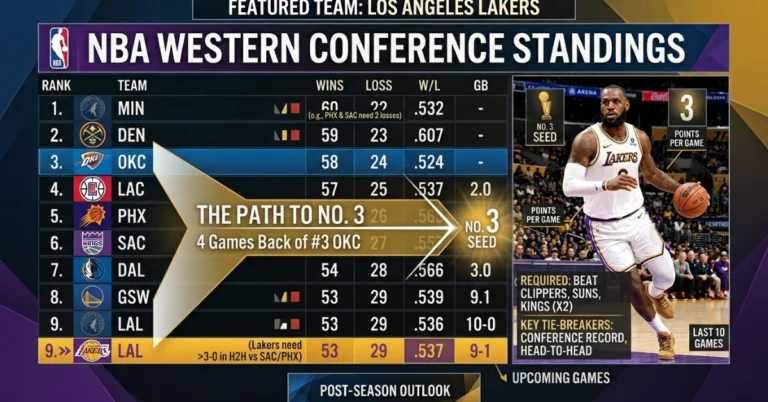
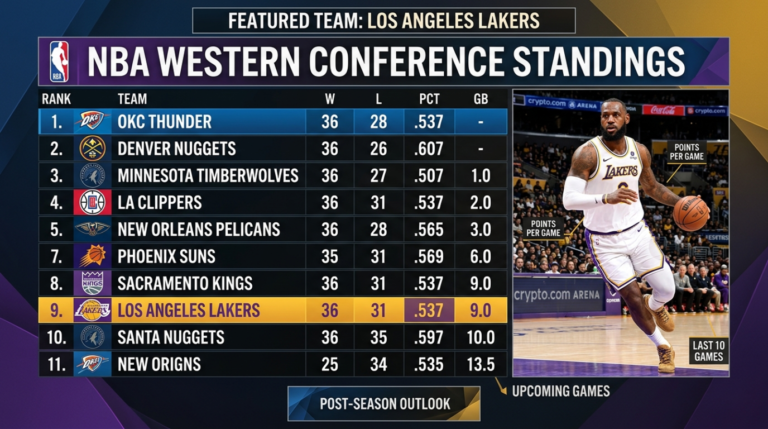
With a 51-29 record, the Lakers sit in fourth place in the Western Conference. The path forward in terms of seeding matters significantly both for playoff ease and for managing injuries during the regular season’s final days.
A victory over Phoenix on Friday, combined with a Houston loss to Minnesota on the same day, would clinch the fourth seed for Los Angeles. This outcome would provide some stability to their playoff positioning and might allow for additional rest management in the season’s final days.
Conversely, if the Lakers fall to the Suns, their playoff picture becomes less certain. The Denver Nuggets, sitting at 52-28, are just one game ahead. The Oklahoma City Thunder and other Western Conference contenders are within striking distance of various seeding positions. Every game carries weight, which makes managing injuries and playing time particularly delicate.
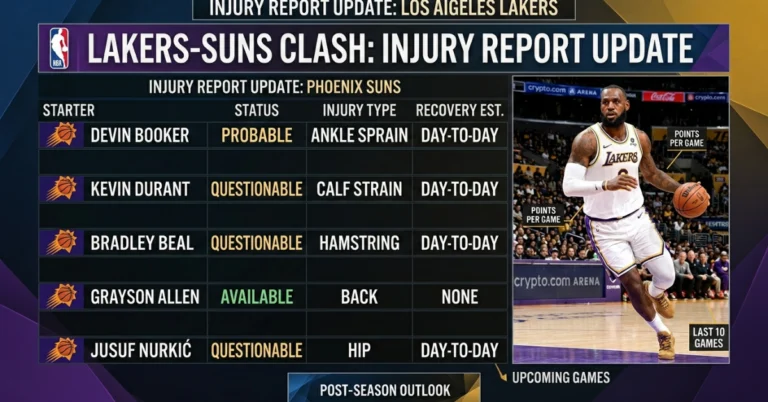
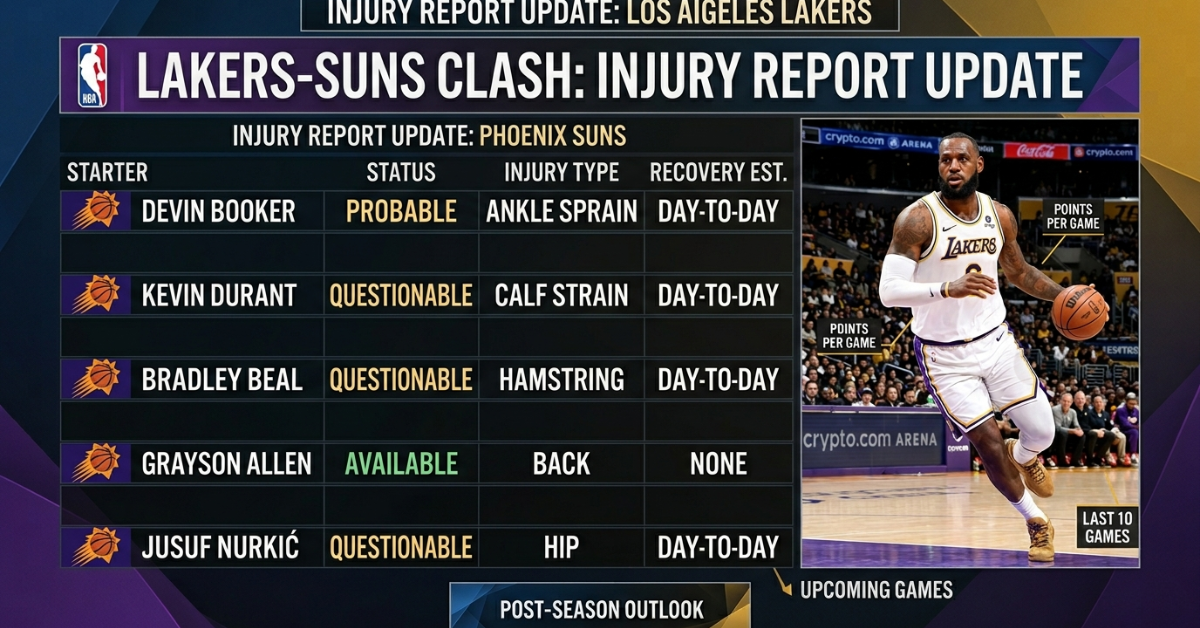
The Suns, notably, are also dealing with injuries heading into Friday’s matchup. Devin Booker (right ankle injury management), Jordan Goodwin (left ankle sprain), and Haywood Highsmith (right knee injury management) have all been ruled out for the game. This means both teams will enter Friday night operating below full strength, though the Lakers’ injury challenges appear more severe on balance.
Luke Kennard: Another Name Enters the Injury Report
As if the Lakers didn’t have enough to manage, sharpshooting guard Luke Kennard appeared on Friday’s injury report with a left finger injury. His status is listed as questionable, adding another element of uncertainty to Redick’s rotation construction for the critical Phoenix matchup.
Kennard’s potential absence would further strain the Lakers’ guard rotation. The veteran sharpshooter provides exactly the kind of three-point shooting and floor spacing that helps in playoff basketball. His on-court presence keeps defenses honest, forcing them to respect the three-point line and creating driving lanes for other offensive players.
The accumulation of injuries—Smart hopeful but unconfirmed, Hayes ruled out, Doncic and Reaves out for the season, James dealing with a hand injury, and Kennard now questionable—creates a layered challenge for Redick in terms of lineup construction and rotation distribution.
The Depth Test
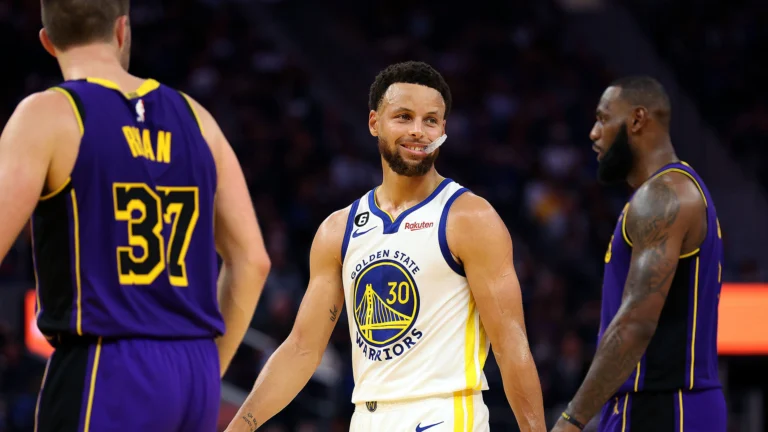
What the Warriors game revealed, despite the injury crisis, is that the Lakers possess sufficient roster depth to compete at a high level. The 119-103 victory was authoritative. Los Angeles controlled the pace, made winning defensive plays, and didn’t appear panicked about missing multiple key players.
This suggests that while injuries have complicated matters, they haven’t completely compromised the team’s ability to function. Role players have stepped up. Young players have contributed. The team’s defensive identity has remained intact even with Smart absent. The ball movement has continued even with Doncic on the sidelines.
Yet depth only carries teams so far. Eventually, the stars are needed—particularly in the playoffs. Every regular-season game the Lakers play without Doncic and Reaves is one less opportunity to build chemistry with that full roster before the postseason begins. The playoff is where depth becomes less relevant and star power becomes paramount.
Medical Caution vs. Playoff Preparation
The tension facing Redick involves balancing medical prudence with playoff preparation. Bringing Smart back too early risks aggravating his ankle and pushing his return further into the future. Yet, leaving him out for games where he could meaningfully contribute denies the team the opportunity to reintegrate him into the rotation and build timing with teammates.
Similarly, the decision about James’ workload involves determining whether managing his rest through the regular season is feasible given the injury situation, or whether the team needs to rely on his presence in order to secure favorable seeding for the playoffs. At 41 years old, James’ availability for 82 games is never guaranteed. The challenge intensifies when injuries to teammates increase the load he must carry.
For Doncic and Reaves, the approach is simpler: recover properly rather than rush back. A Grade 2 hamstring strain and a Grade 2 oblique strain aren’t minor injuries. Pushing either player to return before their bodies are genuinely ready risks converting a 3-to-6-week injury into a much more serious, lengthy absence. The medical community has clear guidance on these matters, and Redick and the team’s medical staff appear to be following it appropriately.
The Human Element
Beyond statistics and strategic considerations, these injuries affect real people dealing with frustration and uncertainty. Smart has been unable to help his teammates for nine games. Doncic and Reaves are watching from the sidelines, unable to influence outcomes on the court. James, at an age when many athletes have retired entirely, continues to push his body and manage pain to keep his team competitive.
For fans, the injury situation creates a different experience of the team. The Lakers are a deep, talented roster—the kind of team that, fully healthy, could compete for a championship. Pieces like Smart, Doncic, Reaves, James, and others form a compelling puzzle. But puzzles with missing pieces don’t reveal their full design.
Looking Ahead: Friday and Beyond
Friday’s game against Phoenix will provide answers to some questions. Will Marcus Smart be available? Will Jaxson Hayes’ foot have healed enough for participation? Will Luke Kennard’s finger injury prove minor or more problematic? How will LeBron James’ hand hold up in competition?
Beyond Friday, the Lakers have one remaining regular-season game—Sunday’s contest against the Utah Jazz. That final game could be an opportunity for additional rest or for continued evaluation of returning players, depending on whether playoff seeding has been clinched.
The real story, however, won’t be written until the playoffs begin. A fully healthy Lakers roster is a formidable competitor. The question facing Los Angeles is whether it can navigate this injury gauntlet and still arrive at playoff time with its key players sufficiently recovered and ready for the postseason push.
For now, Coach JJ Redick’s measured optimism about Marcus Smart’s potential return is a welcome development. But it’s one thread in a much larger, more complex tapestry of injury management, roster depth, and playoff preparation. The Lakers are hopeful. They’re also carefully watching. And they’re continuing to prepare for a postseason that suddenly looks far less certain than it did just over a week ago.
The game against Phoenix on Friday night will be a test—both of the team’s current depth and of the trajectory these injuries are taking. In a season defined by challenge and adjustment, it will be another moment that defines how well Los Angeles can adapt to adversity.
About the Author