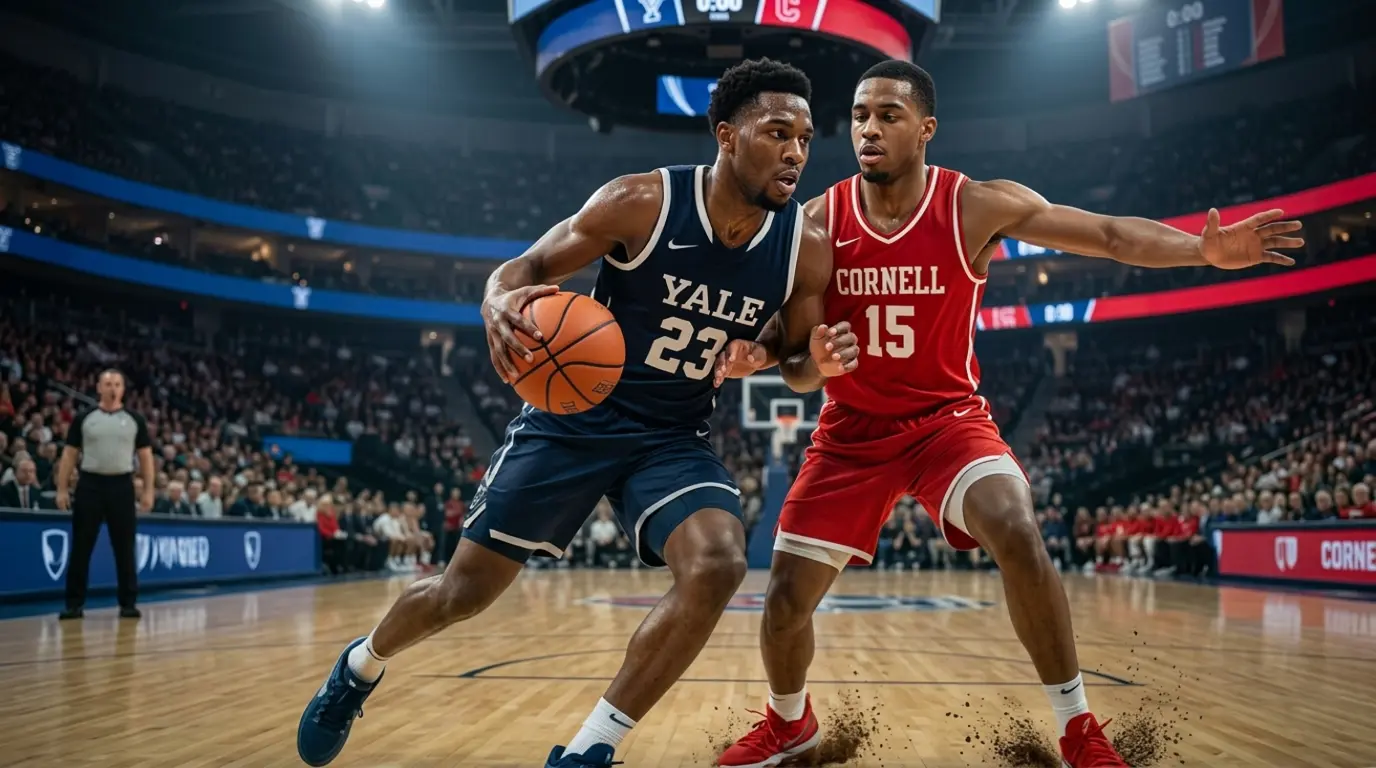
The 2025-26 college Yale vs. Cornell Basketball 2026 season produced one of the most compelling Ivy League rivalries in modern memory: Yale versus Cornell. What unfolded across three meetings—two regular season battles separated by wildly different circumstances, and a high-stakes Ivy Madness semifinal—illustrated why mid-major basketball competition captures the imagination of college hoops enthusiasts and why March Madness begins not with the national tournament, but with conference championships.
New F1 Rules for the 2026 Season – Explore the major changes coming to Formula 1 in 2026, including a shift to 100% sustainable fuels, enhanced electrical power in engines, and new active aerodynamics designed to improve racing wheel-to-wheel.
Yale enters the 2026 Ivy League Tournament as the No. 1 seed with a record of 23-5 overall and 11-3 in Ivy League play, while Cornell comes in as the No. 4 seed at 15-12 overall and 8-6 in conference play. The semifinal matchup between these two programs will take place on March 14 at Newman Arena in Ithaca—the first time Cornell has hosted the tournament—setting up a clash between the conference’s most dominant program and a Big Red team that has become increasingly dangerous as the season has progressed.
Yet the real story of this rivalry transcends seeding and records. It’s a narrative about contrasting styles, defensive philosophies, and the unpredictability of college basketball when two programs collide with genuine tournament aspirations.
The First Meeting: Yale’s Dominant Declaration
The inaugural meeting between these programs on January 17, 2026, in New Haven belonged entirely to Yale. Yale’s men’s basketball team saw five players score in double figures en route to a dominant 102-68 win over Cornell at John J. Yale vs. Cornell Basketball 2026, Lee Amphitheater.
The margin of victory—a staggering 34 points—masked a game that was decided in the opening twenty minutes. Yale’s offense took off after Cornell scored five consecutive points to cut Yale’s lead to 33-26 with 8:08 left in the first half. The Bulldogs followed with a 14-0 run, fueled by three-point makes from Devon Arlington, Nick Townsend, and Riley Fox, to extend the margin to 47-26.
Riley Fox scored 21 points as Yale beat Cornell 102-68 on Saturday. But Fox’s performance, while impressive, represented only one facet of Yale’s offensive dominance. Yale shot better than 70 percent from the field in the opening half (22-of-31) and 53.3 percent from beyond the arc (8-of-15), maintaining control throughout the second half while connecting on 51.5 percent of its shots (17-of-33).
The statistical profile of Yale’s performance revealed why the Bulldogs had established themselves as the clear favorite for the Ivy League tournament title. Yale improved to 13-3 overall and 2-1 in Ivy League play, while Cornell slipped to 7-9 and 0-3 in conference action. Yale finished the game shooting 60.9 percent from the floor and recorded 22 assists on 39 made baskets, committing just five turnovers.
For Cornell, the loss represented a low point in what had been a difficult early season. The Big Red, having begun Ivy play 0-3, appeared overmatched against Yale’s depth, execution, and championship experience. Nick Townsend led Yale with 20 points on 8-of-10 shooting, including 4-for-5 from 3-point range. The senior’s efficiency exemplified Yale’s balanced excellence—multiple scoring options operating at elite levels simultaneously.
The Second Meeting: Cornell’s Stunning Reversal
The narrative changed dramatically on February 27, 2026, in Ithaca. Jake Fiegen scored 17 points, including a go-ahead 3-pointer with one second left, and Cornell beat Yale 72-69 on Friday night.
The three-point margin concealed just how remarkable Cornell’s performance actually was. After surrendering 102 points in New Haven, the Big Red had fundamentally altered their defensive approach and offensive execution. Jake Fiegen shot 7-of-12 from the field with 8 rebounds, while Yale shot 47 percent overall and 35 percent from three-point range.
Cornell shot a nice 48.1 percent from the field and 40 percent (14-of-35) from outside in the rematch, along with a 31-28 rebounding edge. What’s particularly striking about the Big Red’s second-half adjustments: after losing to Yale 102-68 on Jan. 17, a game that saw the Bulldogs shoot 27-for-39 on two-point shots, Cornell was able to flip the script by beating Yale 72-69 in a contest that saw just 64 possessions.
This low-possession, half-court game represented Cornell’s strategic blueprint for neutralizing Yale. Rather than allowing Yale to operate in the fast-paced, open-court system that had produced the January blowout, Cornell deliberately controlled pace and forced Yale into a more methodical offensive approach.
Fiegen was hitting 68.5% of his two-point shots (45th nationally), while Fiegen was at 66.4%. These elite interior shooting percentages, combined with careful pace management, prevented Yale from reaching the offensive rhythm that made them nearly unbeatable.
The final moments epitomized Cornell’s courage and execution. With the game on the line and Yale defending in the final seconds, Fiegen buried the go-ahead three-pointer with one second remaining—a shot that gave Cornell a 72-69 lead and essentially ended Yale’s comeback hopes. The Bulldogs had no time for one final possession, and Cornell had secured a genuinely shocking upset against the Ivy League’s most dominant program.
The Tournament Context: Seeding and Implications
The regular season split between these programs had genuine ramifications for tournament seeding. Yale claimed the league’s number one seed and will take on fourth-seeded Cornell. Harvard earned the second seed and faces off against third-seeded Penn.
Home split: Bulldogs 102-68 on 1/17 and Big Red 72-69 on 2/27. The fact that Yale is going for a three-peat, but Harvard, Penn, and host Cornell are all capable of stopping the Bulldogs reflected the genuine parity that had emerged within Ivy League basketball.
Yale is the top seed and favorite, but Cornell recently earned a home 72-69 win over Yale on Feb. 27, which provides a blueprint for how to compete with the Bulldogs. For Cornell, the February victory wasn’t merely a regular season win—it was evidence that Yale could be beaten, that their apparent dominance wasn’t inevitable.
The Statistical Matchup: Offensive Explosion Meets Defensive Liability
The numbers reveal a stark contrast between these programs’ strategic approaches. Cornell leads the Ivy League in scoring (88.9 PPG) but are last in scoring defense, allowing 83.2 points per game. Yale is first in the Ivy League in three-point percentage (.401), but seventh in three-point percentage defense (.344).
This statistical imbalance creates genuine uncertainty about how the semifinal would unfold. Yale’s superior shooting efficiency and three-point percentage create inherent advantages, while Cornell’s prolific offensive output coupled with their ability to generate stops in crucial moments creates counterbalancing uncertainty.
Cooper Noard is averaging 18.5 points per game, leading the Big Red, while Jake Fiegen averages 16.8 points with 54.3 field goal percentage and shoots 40.8 percent from three-point range. Nick Townsend averages 16.5 points and 7.5 rebounds per game for Yale.
The Semifinal Storylines: More Than Seeding
What makes the March 14 semifinal genuinely compelling transcends conventional tournament preparation. Yale has won in 20, or 83.3%, of the 24 contests it has been named as the moneyline favorite in this year. The Bulldogs have a win-loss record of 20-4 when favored by -166 or better by oddsmakers this year.
Yet Cornell enters with something more valuable than conventional statistics: proof that Yale can be defeated. The February 27 victory wasn’t a fluke—it represented a deliberate, well-executed game plan where Cornell controlled pace, limited Yale’s fast-break opportunities, and generated sufficient defensive pressure to force the Bulldogs into uncomfortable offensive situations.
Yale looks to build off the experience of players such as 6-foot-7 senior Nick Townsend, the Bulldogs’ leading scorer (17.0 PPG). For Yale, the challenge isn’t merely about execution—it’s about preventing Cornell from replicating the defensive strategy and pace control that worked so effectively in February.
The Home Court Advantage: Cornell’s Historic Hosting
Cornell is the penultimate Ivy League member that will host for the first time, with only Dartmouth (2027) left to complete the rotation. The significance of hosting Ivy Madness extends beyond venue logistics. Newman Arena, filled with enthusiastic Cornell fans who will provide sustained support throughout the tournament, creates an environment where Cornell can thrive and Yale must overcome adversity.
The psychological dimension of playing at home in a high-stakes tournament cannot be understated. Cornell’s February 27 victory over Yale occurred in this exact building, with this exact crowd providing energy and support. Repeating that performance with similar home support could prove decisive.
The Player Matchups: Townsend vs. The Big Red Guards
Townsend is ranked eighth in the conference in scoring (16.5 ppg), second in rebounding (7.6 rpg) and assists (4.2 apg), and first in three-point field goal percentage (50.7%). The senior represents Yale’s most impactful player—a 6-foot-7 wing who can score from anywhere on the court and provides elite rebounding and playmaking.
Cornell counters with a different approach: Cornell leads the Ivy League in scoring (88.9 PPG) but are last in scoring defense, allowing 83.2 points per game. The Big Red depend on balanced scoring—Noard and Fiegen providing complementary excellence—rather than a singular dominant performer.
The Tournament Implications Beyond Ithaca
The winner of the Yale-Cornell semifinal advances to the championship game on March 15. Yale is 65th in the nET as of Wednesday, so they’re right on the 12/13 seed bubble. Once again, their three title rivals are further down the table: Cornell is 74 spots lower at 139, while Penn and Harvard are sitting right next to each other at 149 and 150.
For Yale, an Ivy League championship would secure the automatic bid and likely result in a 12 or 13 seed—a significant opportunity to make noise in March Madness with tournament experience and elite offensive efficiency. For Cornell, a championship would represent a remarkable tournament run from the No. 4 seed and likely earn them a 14 or 15 seed opportunity.
The Broader Context: Ivy League Excellence
Yale has won two consecutive Ivy League Tournament championships and four of the past five. While Yale’s dominance has been undeniable, the 2026 tournament reveals genuine competitiveness within the conference. Things are really close in the Ivy League.
This isn’t merely conference-level noise. The quality of basketball being played within the Ivy League—where a No. 4 seed can push the No. 1 seed to the final seconds, where defensive adjustments genuinely matter, where execution in crucial moments determines tournament outcomes—represents basketball at a genuinely compelling level.
Historical Context: The Sweet 16 Connection
Cornell: 2010 (12 seed, Sweet 16) provides historical context for what’s possible from the Ivy League. Cornell’s 2010 tournament run demonstrated that 12 seeds with tournament pedigree and elite execution could advance deep into March Madness. The 2026 Big Red possess some of those same qualities—exceptional shooting, multiple scoring options, and a willingness to execute difficult game plans.
The Prediction: Uncertainty With A Caveat
Prediction: Yale win (70.5%) according to pregame analytics, though any of the four teams is capable of winning the tournament.
Yale’s 70.5% win probability reflects their No. 1 seed status, superior regular season record, and championship experience. Yet Cornell’s 29.5% probability shouldn’t be dismissed—the Big Red enter with genuine hope after defeating Yale on the road just days before the tournament began.
The Final Analysis: Why This Matters
The Yale-Cornell semifinal on March 14 represents more than a tournament game—it’s a clash between two legitimate basketball programs competing for Ivy League supremacy and NCAA Tournament positioning. Yale seeks back-to-back-to-back conference tournament championships. Cornell pursues redemption from a difficult season start and validation of their remarkable late-season surge.
The February 27 victory provided the blueprint. Cornell’s controlled pace, defensive intensity in crucial moments, and reliance on balanced scoring created the circumstances where Yale could be beaten. Whether Cornell can replicate that performance with Yale expecting precisely that approach remains uncertain.
What’s certain: Cornell hosts the tournament at Newman Arena beginning on March 14, and the winner of the Yale-Cornell semifinal advances to the championship game with an automatic NCAA Tournament bid within reach.
About the Author