2026 NCAA Division I Men’s Ice Hockey Tournament | 16 Teams | Regionals: March 26-29 | Frozen Four: T-Mobile Arena, Las Vegas, April 9 & 11
The 2026 NCAA HOCKEY TOURNAMENT TEAMS field is set. Sixteen teams have earned their places in the most prestigious bracket in college hockey — six through the blood and sweat of conference tournament championships, ten through the meritocracy of the new NPI rankings system — and every single one of them believes, with good reason, that Las Vegas awaits them.
Western Michigan is the defending national champion after defeating Boston U. in the 2025 Frozen Four final to win its first title in program history. Denver has the most national championships of any DI men’s hockey program with 10. History is both inspiration and obstacle for every team in this field. Durant surpasses MJ in career points From the No. 1 overall seed with 175 years of combined hockey excellence among their roster, to the Cinderella conference champion who just knocked out three top seeds in their own league, the 2026 field is as deep, as talented and as unpredictable as any in recent memory.
Here is the complete, detailed breakdown of every team that made the 2026 NCAA Hockey Tournament — their path to the bracket, their key players, their strengths, their vulnerabilities, and their realistic road to Las Vegas.
THE FOUR NO. 1 SEEDS
No. 1 Overall — Michigan Wolverines (Big Ten Champions)
Record: 29-7-1 | Conference: Big Ten | NPI Rank: No. 1
Michigan’s dominance this season, after being written off as a rebuilding team, has been one of the biggest stories in college hockey. latest sports highlights on SportsUrge Live. The Wolverines will look to cap off their remarkable season by winning the national championship, which they haven’t won since 1998.
The story of the 2026 Michigan Wolverines begins with a question nobody was asking last spring: how do you rebuild a hockey program after missing the NCAA Tournament entirely? The answer, delivered by coach Brandon Naurato and a roster featuring 15 new faces, has been one of the sport’s great single-season transformations.
Making its NCAA-record 42nd tournament appearance, Michigan will be the top overall seed for the first time since 2022. The Wolverines earned a convincing win in the Big Ten Championship Game against rival Ohio State, 7-3. They are led by Hobey Baker Top 10 finalist T.J. Hughes and Montreal Canadiens first-round pick Michael Hage.
The captain and spiritual leader of this team is T.J. Hughes — a player whose numbers demand examination before any discussion of 2026 college hockey can proceed. Hughes has totaled 50 points in 36 games this season, averaging 1.39 points per game, and has amassed 175 career points. A four-year member of the Michigan program and captain, he has led the team in scoring in back-to-back seasons. Hughes is the all-time Big Ten scoring leader with 108 points in conference-only games.
The captain has tallied 19 goals — including five on the power play and three game-winners — along with 31 assists. A +12 on the year, he has recorded points in 29 games, including a 10-game streak, and has 16 multi-point performances.
Behind Hughes, Michael Hage — the Montreal Canadiens’ first-round draft pick — has been equally dangerous, tied for the team lead with 50 points. Will Horcoff leads the team in goals with 23, making him one of four Wolverines with at least 30 points this campaign.
In goal, the freshman revelation continues. A finalist for the Mike Richter Award, Ivankovic opened his career by backstopping Michigan to the best defensive start in program history, going 7-0 — the first Wolverine goaltender to do so since Paul Fricker in 1979. He owns a 22-7-1 record with three shutouts, 25 quality starts, a .924 save percentage and a 2.11 goals-against average.
Michigan has scored more than 160 goals this season and has allowed only 85 goals all season, averaging about 2.36 goals conceded per game — placing them among the top defensive teams in the country.
Big Ten Tournament Run: The Wolverines earned a convincing win in the Big Ten Championship Game against rival Ohio State, 7-3. Michigan scored five unanswered goals, including four in the third period, to complete a comeback after trailing in the second period. T.J. Hughes, who was named the tournament’s Most Outstanding Player, scored the game-winner with 11:41 left in regulation.
Title odds: 18% — the highest of any team in the field.
Verdict: The complete package. Elite scoring, elite goaltending, elite special teams, experienced coaching. Michigan is the team to beat.
No. 2 Overall — North Dakota Fighting Hawks (NCHC)
Record: Safely in field | Conference: NCHC | NPI Rank: No. 2
NoDak split two games against Western Michigan to secure the top seed in the NCHC tournament and dispatched Omaha in the quarterfinals before losing to Minnesota Duluth in the semis. North Dakota won the NCHC in 2016 — the last time they claimed the national title — and they carry the pedigree of one of college hockey’s most storied programs into 2026. Their loss to Minnesota Duluth in the conference semis was a stumble, not a collapse, and the Fighting Hawks enter the NCAA field as the second-most likely team to reach Las Vegas according to statistical models.
North Dakota’s championship probability sits at 12% — tied with Michigan State for second in the field. Their NCHC regular-season strength, deep roster and tournament experience make them a genuine Final Four contender.
Verdict: Battle-tested, experienced, dangerous. North Dakota’s semifinal exit in the NCHC Tournament leaves questions about their readiness — but NoDak in March is never to be underestimated.
No. 3 Overall — Michigan State Spartans (Big Ten)
Record: Conference regular season champion | Conference: Big Ten | NPI Rank: No. 3
The Spartans lost in overtime to Ohio State in the Big Ten semifinals, falling to 0-2-1 in their last three games against the Buckeyes. Before their struggles with Ohio State, the regular-season champs had won nine of their previous 10 games.
Michigan State won the Big Ten regular-season championship with some of the most dominant hockey in the conference’s history this season, powered by Defensive Player of the Year Matt Basgall and Goaltender of the Year Trey Augustine. Adam Nightingale won Big Ten Coach of the Year — the Spartans’ staff has been the conference’s best throughout the regular season.
The overtime loss to Ohio State in the conference semis was a gut punch — but the NCAA Tournament, played on neutral ice in a single-elimination format, wipes the slate clean. Michigan State’s depth and defensive structure give them a genuine path to Las Vegas.
Michigan State’s title probability: 12%.
Verdict: The regular-season powerhouse whose conference tournament stumble created doubt. Expect a motivated, dangerous Spartans team in the regionals.
No. 4 Overall — Western Michigan Broncos (NCHC — Defending Champions)
Record: Defending national champions | Conference: NCHC | NPI Rank: No. 4
Western Michigan is the defending national champion after defeating Boston U. in the 2025 Frozen Four final to win its first title in program history. The defending national champs took care of business in sweeping Colorado College in the NCHC quarters before falling to Denver in OT in the semis.
The Broncos carry the target of champions on their back and the experience of having been to the mountain top. Their overtime loss to a scorching hot Denver team in the NCHC semis means they enter the NCAA tournament having lost their last game — but defending champions know how to flip the switch when March arrives.
Western Michigan’s title probability: 11% — fourth highest in the field.
Verdict: Champions defend. WMU has the institutional knowledge, the coaching continuity and the roster experience to go deep again.
THE HIGH-PROFILE AT-LARGE TEAMS
No. 5 — Denver Pioneers (NCHC Champions)
Record: Unbeaten in last 13 games | Conference: NCHC | NPI Rank: No. 5
Unbeaten in its last 13 games, Denver has emerged as the hottest team in the country, which is nothing new for the Pioneers in March.
Denver defeated Miami (Ohio) 3-0 and 6-2 in their NCHC quarterfinal sweep, then defeated Western Michigan 2-1 in overtime in the NCHC semifinals before facing Minnesota Duluth in the NCHC Championship. The NCHC Championship final: Minnesota Duluth at No. 2 Denver — a final between two of the conference’s most battle-hardened programs.
Denver has the most national championships of any DI men’s hockey program with 10. They won in 2017, 2022 and 2024. A program this accustomed to winning national championships, on the hottest streak in college hockey heading into March, is arguably the most dangerous team in the entire field right now.
Denver’s title probability: 7% — fifth in the field, but climbing with every passing game of their 13-game unbeaten run.
Verdict: The hottest team in the country. Ten national championships. Denver in March is a different animal entirely.
No. 6 — Dartmouth Big Green (ECAC Champions)
Record: ECAC Tournament champions | Conference: ECAC | NPI Rank: No. 6
Dartmouth finished a strong run through the ECAC tournament with a 2-1 overtime win over Princeton to earn its first NCAA tournament bid since 1980.
Read that statistic again: Dartmouth’s last NCAA Tournament appearance before 2026 was 1980 — 46 years ago. The Big Green have won the ECAC Tournament and returned to the national stage for the first time in nearly five decades, making them one of the most compelling bracket stories in recent tournament history. An Ivy League program, playing with house money and genuine momentum from an overtime ECAC final victory, Dartmouth is the team most fans will circle as their “feel good” story of the 2026 tournament.
Verdict: A 46-year absence ends. Dartmouth’s Cinderella story is just beginning.
No. 7 — Providence Friars (At-Large)
Record: Won 14 of last 16 games | Conference: Hockey East | NPI Rank: No. 7
Entering the postseason, the Friars were the class of Hockey East, winning the first regular-season title in program history and 14 of their last 16 games. But they lost in the conference quarterfinals to No. 8 seed (and eventual champ) Merrimack.
Providence’s quarter-final exit to Merrimack was shocking given their regular-season dominance, but their at-large credentials — built on the best regular season in Hockey East program history — were more than sufficient to earn an NCAA bid. The Friars arrive angry, embarrassed by their conference exit, and motivated to prove their regular season wasn’t a mirage.
Providence has only lost once in its last 13 games and should be considered a dark horse title contender.
Verdict: The best Hockey East team by regular-season metrics. Expect a motivated, dangerous first-round opponent for any higher seed.
No. 8 — Minnesota Duluth Bulldogs (NCHC)
Record: NCHC semifinal winners over North Dakota | Conference: NCHC | NPI Rank: No. 8
The Bulldogs posted their third win of the season over North Dakota in the conference semis before losing to Denver in a double-overtime thriller, so it’s clear they can play with anyone.
Minnesota Duluth won back-to-back national championships in 2018 and 2019. They know how to win in March. Their double-overtime loss to Denver in the NCHC final was a genuine thriller — the kind of game that hardens a team for what is to come in the NCAA Tournament.
Minnesota Duluth’s regional title probability: 11% from their projected regional — the same as Western Michigan.
Verdict: Two-time champions with the depth and pedigree to go deep. Don’t sleep on the Bulldogs.
No. 9 — Quinnipiac Bobcats (At-Large)
Record: ECAC regular-season champion | Conference: ECAC | NPI Rank: No. 9
The Bobcats were the top seed in the ECAC but got swept out of the quarterfinals with a pair of losses to Clarkson. They also showed some cracks the last two weekends of the regular season, suffering a 7-4 loss at Dartmouth and a 6-1 defeat to Cornell.
Quinnipiac won their sixth straight ECAC regular-season title and enter with strong at-large credentials despite their conference tournament implosion. The Bobcats knocked Michigan out of the Frozen Four in 2023 — a fact Michigan’s players have not forgotten and Quinnipiac’s will be happy to remind them of if they meet again.
Verdict: Dangerous despite shaky conference tournament form. Six straight ECAC titles don’t happen by accident.
No. 10 — Penn State Nittany Lions (At-Large)
Record: 22-13-1 in regular season | Conference: Big Ten | NPI Rank: No. 10
Penn State ended the regular season headed in the wrong direction, falling six spots in the NPI after being swept at home by Wisconsin (combined score: 12-5).
Penn State’s saving grace was the emergence of Gavin McKenna — the Big Ten Freshman of the Year and Scoring Champion with 38 points. McKenna won the Big Ten Scoring Champion award as a freshman — a remarkable achievement that speaks to the NHL-calibre talent Penn State has recruited. The Nittany Lions were beaten convincingly by Michigan in the Big Ten semis (5-2) but showed enough competitive quality across the season to justify their at-large selection.
Verdict: A freshman phenom in McKenna and a program on an upward trajectory. Penn State is dangerous when their offence clicks.
No. 11 — Cornell Big Red (At-Large)
Record: ECAC contender | Conference: ECAC | NPI Rank: No. 11
Cornell, Dartmouth and Quinnipiac are locks to earn at-large NCAA berths. The Big Red’s ECAC credentials are unimpeachable — they defeated Quinnipiac 6-1 late in the regular season to demonstrate elite offensive capability. Cornell’s combination of ECAC pedigree and NPI ranking makes them a legitimate threat in any regional matchup.
Verdict: ECAC programs have historically over-performed in NCAA Tournament settings. Cornell fits the profile of a potential upset team.
No. 12 — Wisconsin Badgers (At-Large)
Record: At-large qualifier | Conference: Big Ten | NPI Rank: No. 12
Wisconsin survived a complicated path to the NCAA Tournament field — the Badgers make the tournament in 75% of scenarios based on pre-conference tournament modelling, with their final entry dependent on Michigan’s Big Ten Championship win over Ohio State. Ohio State’s defeat cleared Wisconsin’s path. The Badgers arrive as a legitimate physical Big Ten program with NCAA Tournament experience and the kind of defensive structure that can keep games low-scoring and competitive.
Verdict: A tough out for any opponent. Wisconsin’s physical brand of Big Ten hockey travels well to neutral ice.
No. 13 — Minnesota State Mavericks (CCHA Champions)
Record: 8th regular-season CCHA title in 9 years | Conference: CCHA | NPI Rank: No. 13
The Mustangs were the first team to lock up an automatic berth by virtue of their 4-1 win over St. Thomas in Friday’s CCHA final. Minnesota State has been the CCHA’s most consistent program for nearly a decade, winning eight regular-season titles in nine years. Their automatic bid comes with genuine respect — this is not a program that backs into the tournament.
Verdict: CCHA royalty. Consistent, experienced, and capable of a first-round upset.
No. 14 — UConn Huskies (At-Large)
Record: Hockey East Championship finalist | Conference: Hockey East | NPI Rank: No. 14
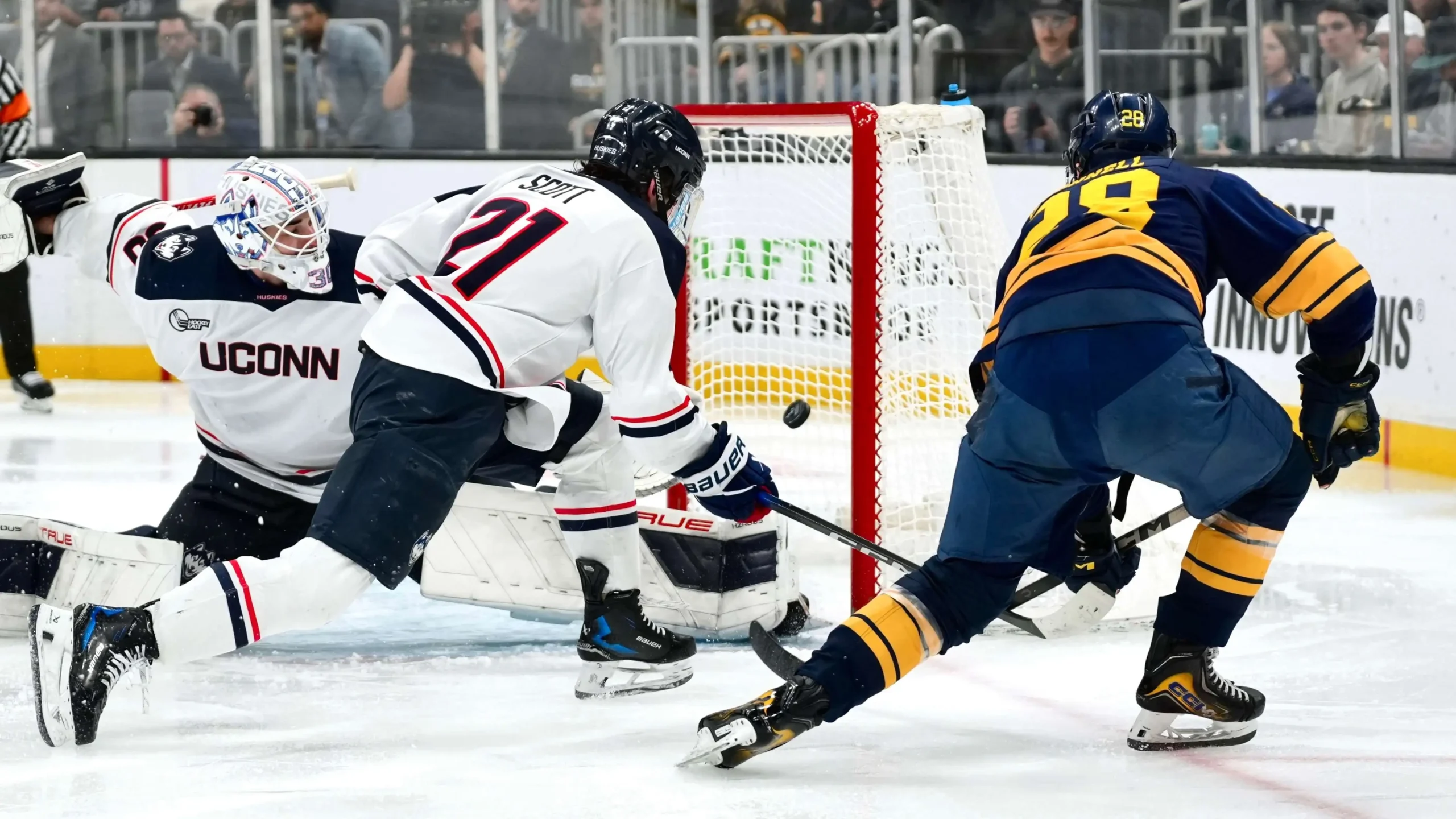
The Huskies lost the Hockey East Championship Game and would have been bounced from the tournament if Ohio State found a way to upset Michigan in the Big Ten Championship Game. UConn got the result it needed and punched its ticket to the tournament as the last team to know their fate.
UConn’s fate hung on the scoreboard of a game they weren’t even playing — watching Michigan defeat Ohio State in Ann Arbor to preserve their at-large standing. It is the most stressful way to earn a tournament bid, and the Huskies enter with the relief of survivors. Whether that emotional roller coaster becomes galvanising fuel or draining anxiety will define their regional performance.
Verdict: Talent is present. Mental fortitude after such a stressful selection process will be the defining factor.
THE AUTOMATIC QUALIFIERS: CINDERELLA CANDIDATES
No. 15 — Merrimack Warriors (Hockey East Champions)
Record: No. 19 in NPI | Conference: Hockey East | Auto Bid
The most staggering story in the 2026 tournament field. The Warriors are the biggest surprise in the NCAA field, beating the top three seeds in Hockey East — Providence, UMass and UConn — to claim their first conference championship.
No. 8 Merrimack defeated No. 9 UMass-Lowell 5-3 in the opening round, then pulled off one of the signature upsets of conference tournament season — knocking out No. 1 Providence 3-2 in overtime before defeating No. 2 UMass 4-1 in the final to claim the Hockey East championship.
Merrimack’s NPI ranking of No. 19 means they are statistically one of the weakest teams in the field by regular-season metrics. But the Warriors just beat the three best teams in Hockey East back-to-back-to-back. Whatever their regular-season record says about them, their current form says something entirely different.
Verdict: The Cinderella of the 2026 tournament. Momentum, belief, and nothing to lose. Watch out.
No. 16 — Bentley Falcons (Atlantic Hockey Champions)
Record: No. 24 in NPI | Conference: Atlantic Hockey | Auto Bid
The Falcons were the class of Atlantic Hockey all season, finishing things off by beating Sacred Heart 3-2 for the conference title. Although the lowest-ranked team, do not count out Bentley goaltender Nicholas Bevilacqua from making this closer than Michigan would like.
Every bracket has a 16-seed, and every 16-seed in college hockey has a goaltender who can stand on his head and make a game of it. Bevilacqua is exactly that — the kind of elite goaltender who can turn an Atlantic Hockey automatic bid into a genuine first-round scare.
Verdict: The classic underdog. Their path to an upset starts and ends with Nicholas Bevilacqua stopping everything Michigan throws at him. Unlikely, but in hockey — always possible.
The Projected Bracket
Here is the projected bracket based on NPI seedings and committee placement logic:
Albany Regional (Northeast): No. 1 Michigan vs. No. 16 Bentley No. 8 Minnesota Duluth vs. No. 9 Penn State
Sioux Falls Regional (Midwest): No. 2 North Dakota vs. No. 15 Merrimack No. 7 Providence vs. No. 10 Quinnipiac
Worcester Regional (East): No. 3 Michigan State vs. No. 14 UConn No. 6 Dartmouth vs. No. 11 Wisconsin
Loveland Regional (West): No. 4 Western Michigan vs. No. 13 Minnesota State No. 5 Denver vs. No. 12 Cornell
Championship Probability: Who Reaches Las Vegas?
The statistical model gives Michigan a 18% chance of winning the national championship, with North Dakota and Michigan State each at 12%, Western Michigan at 11%, and Denver at 7%. The NCHC’s four teams combined represent 42% of the field’s championship probability — a reflection of that conference’s extraordinary dominance, having produced seven of the last nine national champions.
The NCHC has produced seven of the last nine national champions, including four different winners — North Dakota (2016), Minnesota Duluth (2018-19), Denver (2017, 2022, 2024) and Western Michigan (2025) — all currently represented in the 2026 field.
The road to Las Vegas runs through these sixteen teams. It begins in Albany, Sioux Falls, Worcester and Loveland on March 26-27. And it ends — for one program, with ice falling from the rafters and a national championship trophy raised — at T-Mobile Arena in Las Vegas on April 11, 2026.
2026 NCAA Division I Men’s Hockey Tournament | Selection Show: March 22, 3 p.m. ET, ESPNU | Regionals: March 26-29 | Frozen Four: T-Mobile Arena, Las Vegas, April 9 & 11 | Championship: April 11 | All games: ESPN networks & ESPN+
About the Author